


Today's News



 A/CPB
A/CPB

Caribou Migration Update: February 20, 1997
Robert Mulders

Robert Mulders sends greetings from northern Canada, and more data from the Qamanirjuaq caribou herd. After plotting today's data, see if you can answer this Challenge Question:
Challenge Question #2
"How far did Caribou # 3924 travel between February 6 and February 11? Between February 11 and February 16? In total, how many miles do you think she moved?"
To answer this Challenge Question please follow the instructions at the end of this report.
How to Plot Satellite Data
The instructions provided in last week's bald eagle update can be adapted for tracking caribou. CLICK HERE FOR Step-by-step instructions and a useful chart which will help you pinpoint each caribou's location. Remember, you will need to find the scale of the map you are using.
Tick Tock, Caribou Clock
Time must pass slowly for caribou during the long, cold winter. Yet as they can surely tell, time for migration is approaching. Day length in the arctic has begun its dramatic spring surge, their cue that the season in changing. In this and in future reports, sunrise and sunset data from the caribou's corner of the world will be provided. (See the chart below. We began with the shortest day of the year.) By monitoring these changes, you can tell time as the caribou does. Calculate and graph the photoperiod, and watch how it changes over the season. (To find the photoperiod, count the number of hours and minutes between sunrise and sunset.)
Date          Sunrise     Sunset      Photoperiod
12/20/96        09:28       14:42         05:14
01/20/97        08:59       15:38         06:39
02/06/97        08:17       16:26         08:09
02/20/97        07:36       17:07         09:30
Congratulations to the following students for bright answers about daylength in the arctic on February 6th! Here's how they responded to our last Challenge Question: Iselin Middle School students (susamel@mci.pppl.com) calculated 8 hours and 13 minutes, Ms. Lobb's period 5 & 6 classes in Hudson Falls, New York came close with 8 hours 20 minutes (hfmiddle@global2000.net), and Texas students Aaron & Andrew in Mr. Palmer's class (dpalmer@mckinney.isd.tenet.edu) figured the amount of daylight was 7 hours and 53 minutes. Nice going!
Purdue University
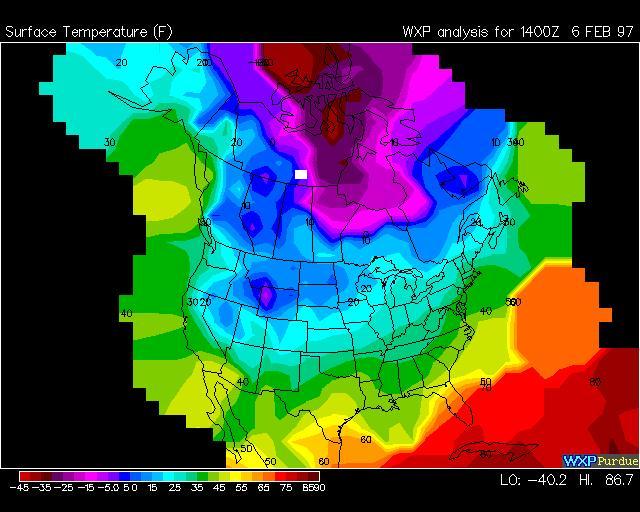 How Cold in Caribou Country?
In our last Challenge Question we also asked how cold it was for Caribou # 6977 on February 6th. According to this temperature map which was downloaded from the Purdue University Weather Processor, it appears to have been a balmy 0 F on that day at 7 am local time. (The time "1400 Z" printed on the map stands for 14:00 o'clock "Zulu". This refers to the time in Greenwich, England. Since the caribou are 7 time zones to the west of Greenwich, it was 7 hours earlier, or 7 am.)
Although they were far away, Ms. Talbert's students in California came the closest with their guess of -3F. Here's what they did: "First we figured out where the caribou was by using the longitude and latitude on a map. When we found where he was, we used the newspaper to find out his temperature. We found that he is at -3 F." (ltalbert@mail.mcn.org)
Chris Gowan and Andrew Baumann, Ms McGinley's students in Maryville, Tennessee came close also with an estimate of -10 F. "We found this information that was on a Web Site on Netscape Navigator on a weather map of Canada. The 6 caribou must be traveling close together and are experiencing the same weather conditions." (MCGINLEYL@ci.maryville.tn.us)
Purdue University
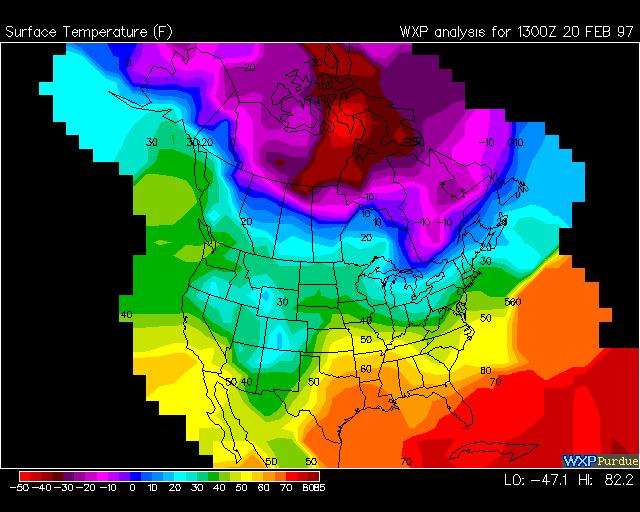 As we track the caribou over the next months, we'll also keep close track of temperatures in the region. As you can see from today's map, it's was chilly -35 F at 1300 Z (or 6 am local time.) As day length increases, how quickly will temperatures rise? Plot temperatures in caribou country during the spring season and find out!
By the way, if you've found other good sites on the WWW where temperature data, please let us know: Send a message to: jn-talk@learner.org.
As we track the caribou over the next months, we'll also keep close track of temperatures in the region. As you can see from today's map, it's was chilly -35 F at 1300 Z (or 6 am local time.) As day length increases, how quickly will temperatures rise? Plot temperatures in caribou country during the spring season and find out!
By the way, if you've found other good sites on the WWW where temperature data, please let us know: Send a message to: jn-talk@learner.org.
George Calef/Gov't. of NWT

Off the Top of Your Head
Any idea why caribou have such amazing antlers? Imagine balancing heavy bones on your head and carrying them everywhere you go! Unlike other kinds of deer, male and female caribou both have antlers. The male's antlers are much larger and more impressive than the females', spreading as much as 44 inches across! Year after year, the antlers are grown and shed, then re-grown and shed again. This growth uses hard-earned energy--one can't help but wonder why.
In nature, for everything there is a season--and there's also a reason! Here caribou biologist Doug Urquart describes the seasonal differences between the antlers of males and females.
"Antler development is 3-6 months out of phase between the sexes. For example, the male's antlers begin developing in March, grow rapidly from May to July, and are completely hardend and out of velvet by mid-September. Following the rut, antlers are shed in early November by older males, but may be kept until April by some of the younger ones. Female antlers develop from June to September and are out of velvet by late September. The females' antlers are retained throughout the winter. Pregnant females drop their antlers within days of calving. Barren cows shed their antlers before the spring". (Provided courtesy of the Government of the Northwest Territories, Division of Natural Resources.)
See if you can answer today's Challenge Question and guess the reason for the seasonal differences Urquart describes:
Challenge Question # 3
"For what reasons might female caribou keep their antlers during the winter, while males drop theirs in the fall?"
To respond to this question, please follow the instructions at the end of this report. Try to think of the different ways antlers can be used. Remember, WHEN something happens often helps explain WHY it happens.
After our last report, this message arrived from the elementary school in Robert Mulder's own community :
"'Ublakut' from Rankin Inlet, Northwest Territories!
Please check out our web site. We would very much like to make a link from our web site to your caribou page in particular.
Mutna! (Thank you).
Taima, Bill Belsey, Computer Program Coordinator
Leo Ussak Elementary School, Rankin Inlet, NT
P.S. Please tell your caribou expert Robert Mulders a big "Ublakut" from
all of us!!!"
Visit to this award-winning WWW site, it's well worth the trip. You can learn all about Rankin Inlet, read the school newsletter in Inuktitut and English, and even visit each of the grade K-6 classes by a click on the school map! Here's what we found:
"Welcome to the warmest school in Canada's Great White North, the first school in Canada's Arctic on the WWW!!! Our students learn English and Inuktitut. Inuktitut is the traditional language of the Inuit (formerly known as Eskimo people). Inuktitut means "to sound like an Inuk". Although Inuktitut has been spoken for thousands of years, Inuktitut has only been written in recent years. Many Leo Ussak students had the chance to see hunter Tuma Saumik and the polar bear that he caught and skinned close to our school. Local hunters are given the chance to hunt a carefully controlled number of bears each year. The meat is used for dog teams and the fur is used to make VERY warm clothing which we definitely need up here!"
How to Respond to Journey North Caribou Challenge Question # 2
- Address an e-mail message to: jn-challenge-caribou@learner.org
- In the Subject Line of your message write: Challenge Question #2
- In the body of the message, give your answer to this question:
Challenge Question #2
"How far did Caribou # 3924 travel between February 6 and February 11? Between February 11 and February 16? In total, how many miles do you think she moved?"
How to Respond to Journey North Caribou Challenge Question # 3
- Address an e-mail message to: jn-challenge-caribou@learner.org
- In the Subject Line of your message write: Challenge Question #3
- In the body of the message, give your answer to this question:
Challenge Question # 3
"For what reasons might female caribou keep their antlers during the winter, while males drop theirs in the fall?"
Don't Forget!
Please include the name of your school and your location so we can credit you properly for your answers!
The Next Caribou Migration Update Will be Posted on March 6, 1997.