


Today's News



 A/CPB
A/CPB

Caribou Migration Update: March 6, 1997
Everyone's heard of a caribou "herd", but have you ever wondered where the definition comes from? Through tagging studies conducting in the late 1950's, caribou were found to return to the same calving area each year, regardless of where they spent the winter. Thus, since that time each caribou herd has been named after its traditional calving grounds. The Canadian Wildlife Service researcher who did this work named each of Canada's herds. Each herd is named after a body of water near the calving grounds.
The caribou you're tracking with Robert Mulders this season gave birth last spring in the Qamanirjuaq caribou herd calving area, near Qamanirjuaq Lake. Mulders is watching the collared caribou with renewed interest this season. This is because all 6 caribou are spending the winter much further to the west than he expected. In fact, they are in what would appear to be territory of the neighboring herd, known as the Beverly Herd. "It's going to be interesting to see if these caribou actually join the Beverly herd", said Mulders. Perhaps they'll challenge the definition of a herd while we're watching. It's just a theory, after all!
Charlie Fitzpatrick, ESRI
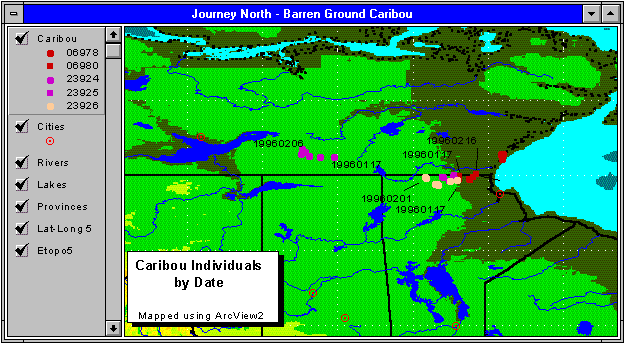 This map shows where 5 of the 6 caribou were last year at this time. Have a look at today's satellite data and then see if you can answer this question
- Click Here for Today's Satellite Data
Challenge Question # 4
"What do you think might determine the location of the caribou's wintering grounds each season? Why might they change locations from winter to winter?"
Challenge Question # 5
"What is the name of the biome the caribou are in this winter?"
To respond to these questions, please follow the instructions at the end of this report.
Although it may be warming up where you are, it's still quite cold for our caribou! At 9 am (16 Z) today, the temperature read -20 F! We can report that the days are clearly getting longer. How many minutes of daylight have the caribou gained in the last 2 weeks?
Date         Sunrise     Sunset      Photoperiod
12/20/96        09:28       14:42         05:14
01/20/97        08:59       15:38         06:39
02/06/97        08:17       16:26         08:09
02/20/97        07:36       17:07         09:30
03/06/97        06:47       17:41
Catherine Timberg/Gov't. of NWT
 These Feet are Made for Walking
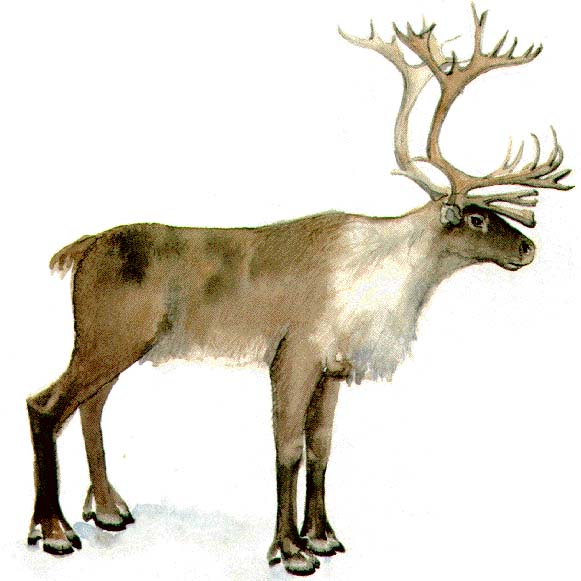
Although not elegant, the caribou's feet are beautifully designed. With each step, the caribou's weight spreads onto large, concave hooves. Like 2 sets of snowshoes, these hooves help keep the caribou from sinking into the deep snow. The feet also work like scoops, which the caribou uses to dig for food. When in water, they serve as paddles for swimming. Caribou are even named after their feet! The word "caribou" is believed to come from the Micmac word "xalibu, which means "pawer" or shoveler". Although caribou are generally silent animals, they make a unique clicking sound when they walk. This is caused by movement of the tendons and bones just above their hooves. One author describes the sound of caribou migration, "Like the timekeeping ticking of a thousand metronomes, the clicking of the caribou's ankle bones counts cadence for the marchers. The mass moves with a single mind, following a route trod by countless generations."
In our last report we asked Challenge Question # 3, "For what reasons might female caribou keep their antlers longer than males?
Students' answers were NOT off the top of their heads! They clearly gave this question a lot of thought. The Caribou Study Team from Blue Hill Consolidated School in Blue Hill, Maine reasoned, "We think the females keep their antlers when they're pregnant for protection. They lose them when the calf is born so they don't hurt the calf." (bhcs@downeast.net)
According to caribou biologist Dough Urquart, during the winter the female does use her antlers for protection from males. She uses them to defend her feeding craters from the larger, but antler-less males. This provides a survival advantage for the female and for her unborn calf as the Maine students suspected. There's another calf who benefits too. Last year's calf is still with her, and the mother shares her feeding craters with this young calf. First-year calves grow antlers when they're 3 months old, and also keep them all winter. Many of these young calves die during their first winter, as Robert Mulder's survey later this month will measure.
- Click Here to see student answers to Challenge Question # 3.
Challenge Question #2 "How far did Caribou # 3924 travel between February 6 and February 11? Between February 11 and February 16? In total, how many miles do you think she moved?" This is very hard work for us--but remember, it's much harder for the caribou! Imagine Kirsten & Loanne of G. Seitz Elementary School in the sunny Marshall Islands plotting their travels. (Nice work girls!) (gses@tcsn.net) Students at Angevine Middle School in Lafayette, CO (sands@ucsu.colorado.edu) and Jefferson Scranton Middle School in Jefferson, Iowa (morainm@jefferson-scranton.k12.ia.us) also worked this one out.
- Click Here to see student answers to Challenge Question # 2.
It's helpful to make a grid on your map, with each square marking a full degree. This way, you can see the fractions of degrees the caribou moves. Here are our figures:
Dates  Change Lat., Long     (Distance Traveled)
2/06-2/11 .007 North, .591 East (22 miles)
2/11-2/16 .212 North, .158 West (17 miles)
How to Respond to Today's Challenge Questions:
Please do not answer both questions in one message!
How to Respond to Journey North Caribou Challenge Question # 4
- Address an e-mail message to: jn-challenge-caribou@learner.org
- In the Subject Line of your message write: Challenge Question # 4
- In the body of the message, give your answer to this question:
Challenge Question # 4
"What do you think might determine the location of the caribou's wintering grounds each season? Why might they change locations from winter to winter?"
How to Respond to Journey North Caribou Challenge Question # 5
- Address an e-mail message to: jn-challenge-caribou@learner.org
- In the Subject Line of your message write: Challenge Question # 5
- In the body of the message, give your answer to this question:
Challenge Question # 5
"What is the name of the biome the caribou are in this winter?"
Don't Forget!
Please include the name of your school and your location so we can credit you properly for your answers.
The Next Caribou Migration Update Will be Posted on March 20, 1997