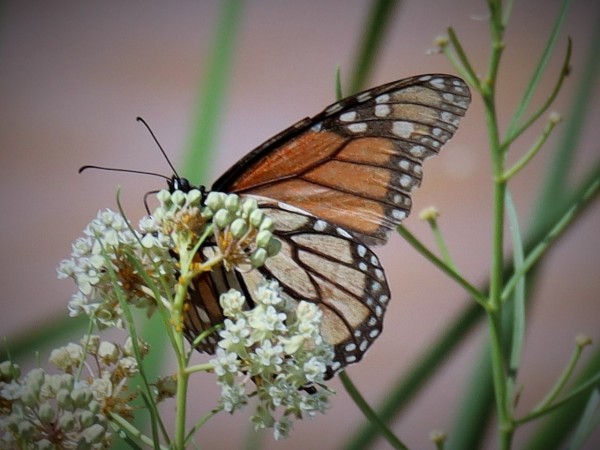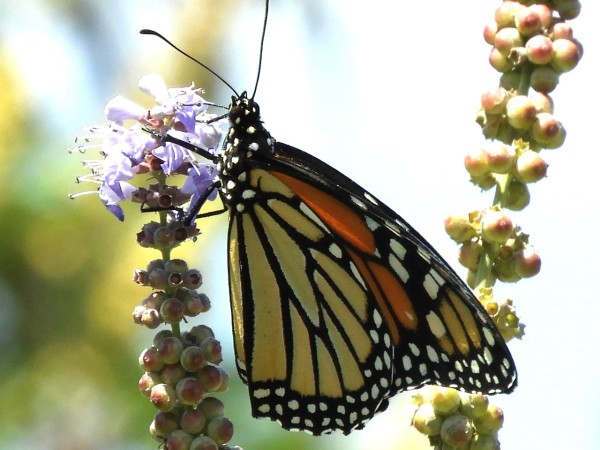
Western movement continues



The monarch migration generation is appearing across northern portions of the West, and monarchs are beginning their journey to the overwintering sites. They will be joined by freshly eclosing monarchs on their flight south and west. Fall-blooming nectar resources play a premier role in increasing their lipids to fuel their long journey ahead.
While most western monarchs head to the California coast, others continue further south to Mexico. Community scientists across the region are grabbing their nets to tag monarchs in the hope of learning more about their migration flight and destination.
In Show Low, Arizona, Dan reported tagging nine monarchs on Aug. 22.
Note: Tagging monarchs is not a component of the Journey North program. If you would like to participate in a community science program that tags monarchs, please check out the Southwest Monarch Study or Monarch Watch, or a conservation group near you that does tagging demonstrations or events.
Recent Sightings
Monarchs continue to be reported in increasing numbers in California, and Utah is also having a good monarch year. They are now seen stretching across the West as migration grows near.
Theresa in Los Angeles, California, spotted one monarch on narrowleaf milkweed in her yard on Aug. 24, and another on Aug. 28. A day earlier than the first report, across town, Margaret reported, “Monarchs flying around my patios every day since June. I had over 25 caterpillars, one chrysalis on the milkweed plant itself, and I even watched two monarchs mating.” Pamela in San Rafael, California, saw two monarchs on Aug. 23 as well.
Reports are also coming in from Utah. Martina in Ogden, Utah, shared, “36°C, sunny day, no wind. Two monarchs sailing around the yard for the last four days. Butterfly bushes in full bloom.”
In Fairacres, New Mexico, James also saw monarchs flying near the border with Mexico on Aug. 22. “Along a four-mile reach of the Rio Grande, eastern embankment, two monarchs were observed each taking nectar from horsetail milkweed flowers. The observations were ~1.5 miles apart, this observation was north of the I-10 bridges.”
Two days later, C.J. in Las Cruces reported an adult monarch as well.
In Lakewood, Colorado, Mary reported a monarch on Aug. 22, writing that it was "observed flying and nectaring on agastache in the garden. Did not go near the milkweed plants."
Reports from the Field
Rachel Taylor in Salt Lake City, Utah, shared some positive news from the Beehive State:
“We seem to be having a strong year along the Wasatch Front in Utah. I’ve personally had a male set up residence in my pollinator park strip, and he is now finishing his third week fluttering about, waiting for females to pass by. I’ve got great videos of him chasing off other males, and allowing a female to share a Liatris stem with him. The entire neighborhood watches for him now. “I had a female lay eggs for two days on a large stand of A. fascicularis – she was very fun to watch. The little bloom buds had half a dozen eggs on them. My sense is that we are maybe double what we saw last year, but I haven’t tallied the posts in the group yet.”
Rigors of Migration
Community scientists across the West are swinging their nets to catch monarchs to tag on their fall migration. They are always hoping to hear news that their tagged monarch reached the overwintering sites safely. The excitement is palpable when they receive a call and hear that their monarch was sighted, but the migration is also a time of weeding out the weaker participants in this flight marathon as they stop to hunt for rich nectar to refuel along the way. Today I was reminded that not all migrating monarchs reach their goal successfully when I opened an email reporting a tagged monarch sighting, found dead on someone's lawn in Kaysville, Utah.
The butterfly was missing its head and most of its legs, and was being scavenged by wasps when Reed, the tag reporter, found it. He suspected it had been hit by a car on a busy local street.
I’m grateful that Reed reported this deceased monarch. While we won’t know for certain what caused this particular monarch’s demise, they face many obstacles and predators along the way. A monarch’s toxicity is concentrated in its wings, but a predator can devour its abdomen and other parts and leave the wings behind. I’m the first to admit these are not easy nor exciting calls to make to the tagger, but it is a reminder of how perilous the migration is. We send all our tagged monarchs off with a hope-filled wish for a safe journey.
Monarch and Milkweed Sightings Needed!
Seeing monarchs? Your sightings help us present a balanced and accurate report of where monarchs are appearing each week. Report adult monarchs, eggs, and larvae to Journey North. Your detailed description of what you see can include, but is not limited to, the monarch’s gender and activity. If known, include the type of flowers if they are nectaring or milkweed type if laying eggs. Photos are encouraged and welcomed with all your reports.
Gail Morris is the coordinator of the Southwest Monarch Study (www.swmonarchs.org). She is also a Monarch Watch conservation specialist, the vice president of the Central Arizona Butterfly Association and participates in several western monarch working groups. The Western Monarch News is based on comments provided to Gail Morris. We hope to increase the number of sightings and therefore, photos and comments entered into Journey North. We rely on the volunteers who communicate regularly with Gail and who agree to participate in our effort to increase awareness of the population of western monarchs. You can reach her at gail@swmonarchs.org.