First monarchs arrive at California sites, roosts in Texas


Western update
By Gail Morris, Southwest Monarch Study coordinator
The fall migration race to the overwintering sites continues across the West as the first monarchs are appearing and being counted at the Santa Cruz locations.
Wayne in Pocatello, Idaho, saw one in his garden on October 3, and Anette reported one on Sept. 27 in American Fork, Utah, writing, “I was in this 15-acre habitat for five minutes when this monarch flew overhead. I was seed-gathering and did not have my tagging equipment with me. Hope he finds some friends to migrate with. Beautiful fall day, in the 70s, late afternoon. The milkweed was dying, lots of Russian olives and sunflowers. Joe Pye was probably gone, but I didn’t get that far."
More monarchs appeared further south. On Oct. 1, Harold in Phoenix found one, writing, “Sitting on Vitex tree (aka chaste tree) in backyard. We also have three milkweed plants in the backyard and a couple in the front yard, but I have never seen any monarchs around them before. This was our first sighting after being in this house four years. Woot. Woot.”
Joshua in Mesa spotted one on October 3, writing, “Was flying through a stormwater garden. Close to the ground, about 1-3 feet. Briefly landed on vegetation and continued in a south-eastern direction.”
Take a moment to look at the adult monarch maps, and you can see the density of monarch sightings rising as they fly through to their goal of the winter overwintering sites. Cynthia in Stockton, California, noted one monarch on September 23, writing, “This healthy-looking female nectared on our butterfly bush for a few hours this afternoon/evening. This was exciting for us as we've only had two other visitors this season. Today was hot, 95°+, and this individual seemed to be pestered by, or admired by, our resident gulf fritillary butterflies. But that didn't deter it from feeding.”
Bob in Napa, California, reported one on September 26: “Monarch feeding on zinnias and cosmos in the garden.” On October 3, Theresa in Los Angeles saw one monarch "around the narrow leaf milkweed patch.”
Reports from the Field
Diana Magor, Santa Cruz, California
Yesterday, Oct. 2, Elizabeth Bell and I did a preliminary search for monarchs at Lighthouse Field State Beach and Natural Bridges State Beach. We found 13 at Lighthouse Field and six at Natural Bridges.
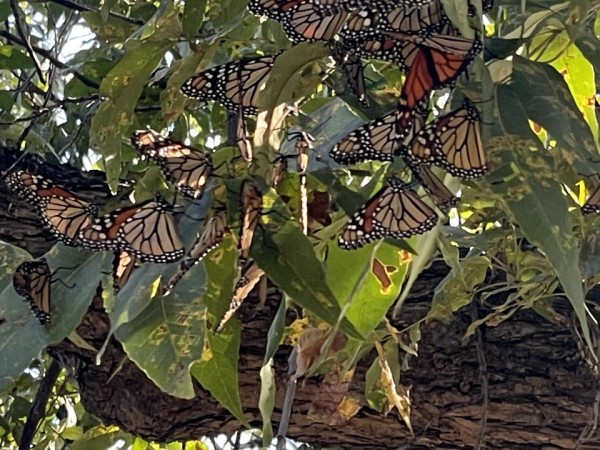
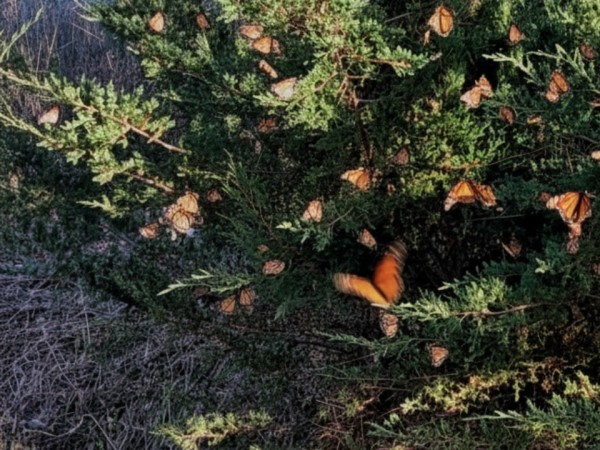
This morning, I did our first official count of the fall season, Oct. 3, at Lighthouse Field, and counted 15, including two females. Weather: calm, sunny, ~64°, becoming partly cloudy at the end of the survey at 9:40. The majority were sunning on young eucalyptus trees on the eastern border of the monarch grove. There were several loose aggregations, with three that might generously be called clusters. All were roosting, mostly on young eucalyptus, most sunning, except 1 flyer at the end of the survey that landed on a large eucalyptus at the west end of the grove. I found none inside the grove, except for the few on the old eucalyptus on the far west end near the viewing area.
This count is similar in time and number with last year’s count of 10 plus two possibles that I found Oct. 3, shielding from the high 80° temperature on the north side of the large old eucalyptus on the far west side of the grove.
All this is going on across the narrow Pelton Road from two construction sites and adjacent to an active yellowjacket ground nest only 20 feet from the trees on the eastern border of the grove where the majority of the monarchs were found yesterday taking in the morning sun! We have asked since mid-September that this nest be destroyed, but it remains. The California Department of Fish and Wildlife finally had to request its removal today.
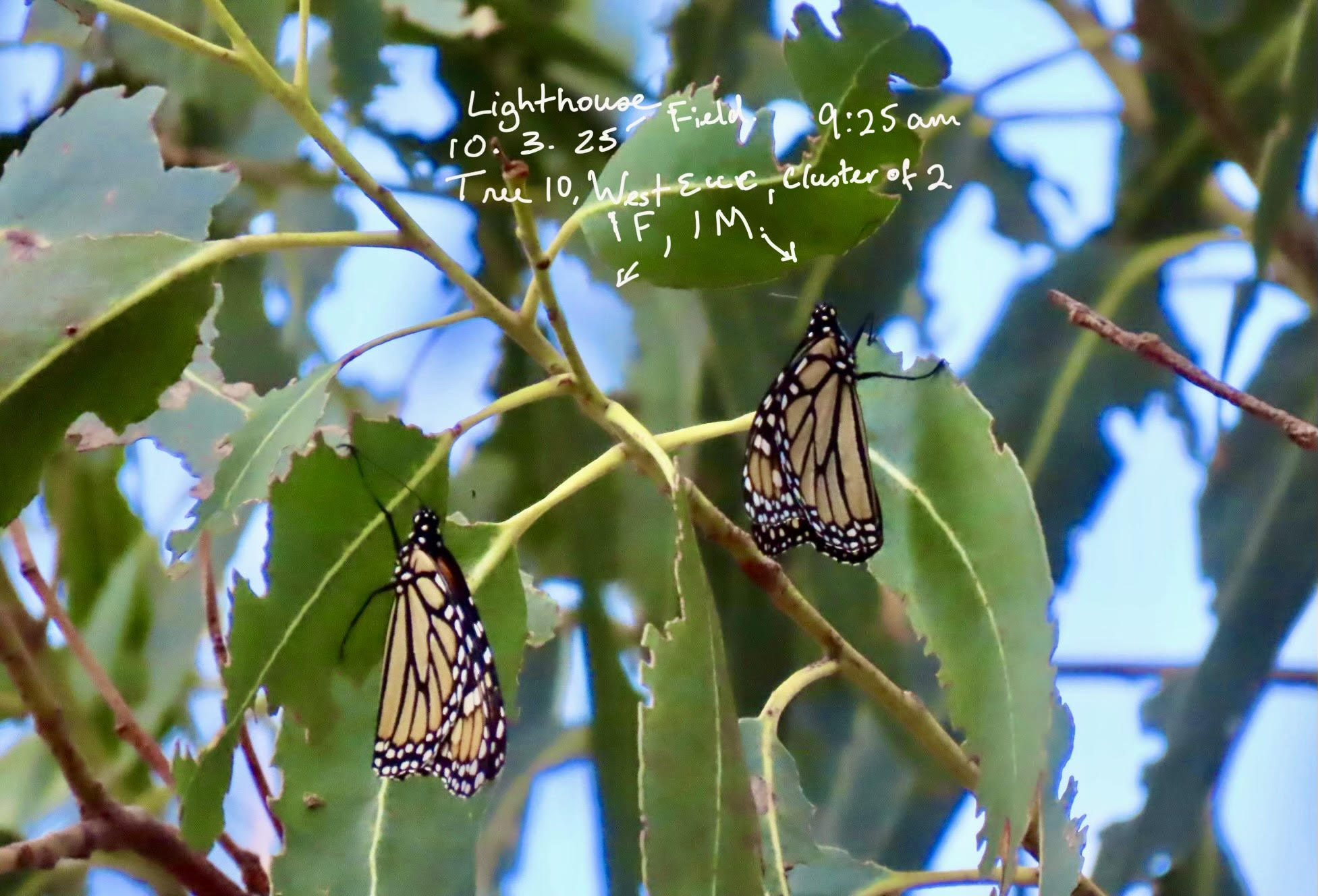
At Natural Bridges on Oct. 2, we found only six monarchs, all males as far as we could tell. On the right, you can see a photo of a male and female monarch roosting in the shade on an old eucalyptus on the far west side of the Lighthouse Field grove.
Gail Morris, Arizona
Monarchs are appearing across the state and working their way south with a small number of sightings across the region. Most are noted in larger population centers like the greater Phoenix area.
Over the last ten days, I’ve seen a constant drip of one or two monarchs that stay one to three days in my yard and nectar heavily and then move on. The numbers are light but constant. Yesterday, we drove out to look for monarchs along the Colorado River on the border between Arizona and California. Usually, we find monarchs here in Parker or Lake Havasu, but this time so far, we have been unsuccessful. We’ll continue our search and let you know next time what we find.
Monarch sightings needed
Seeing monarchs? Your sightings help us present a balanced and accurate report of where monarchs are appearing each week. Report adult monarchs, eggs, and larvae to Journey North. Your detailed description of what you see can include, but is not limited to, the monarch’s gender and activity. If known, include the type of flowers if they are nectaring or milkweed type if laying eggs. Photos are encouraged and welcomed with all your reports.
Gail Morris is the coordinator of the Southwest Monarch Study. She is also a Monarch Watch conservation specialist, the vice president of the Central Arizona Butterfly Association and participates in several western monarch working groups. The “Western Monarch News” is based on your comments provided to Gail Morris. We hope to increase the number of sightings, photos and comments entered into Journey North. We rely on the volunteers who communicate regularly with Gail and participate in our effort to increase awareness of the population of western monarchs. You can reach her at gail@swmonarchs.org
Eastern update
By Jacob Swanson, Journey North program coordinator
Since our last update, monarchs have continued their southern migration, with roosts being reported through the middle of Texas.
As of Oct. 10, we've received 17 roost reports in Texas since the first one on Sept. 30, which came from Lynn in Wichita Falls, who wrote, "monarchs are beginning to roost in the willow trees in singles, twos, and small groups."
Our southernmost roost report came from Marie in Mason, Texas, who reported 100 monarchs on Oct. 1.
Larger reports have followed, including one report of 500 in Abilene from Rendi on Oct. 9 and 150 from Amanda in Abilene on the same day.
It's not just Texas that's seeing roosts, with roosting activity across the Great Plains states. So far in October, we're received reports from Illinois, Oklahoma, Missouri, Nebraska, Kansas, Indiana, and Iowa.
Mark in Chapman, Kansas, reported 1,000 on Oct. 4, writing, "Was collecting pitcher sage seed near Kansas Flinthills when monarchs landed all around me ... first ever sighting like this."
Others are seeing monarchs in familiar areas, like Lorne in Marengo, Iowa, who estimated 500 monarchs on Oct. 5, writing, "Has been doing this for over 50 years at this location."
A race against time
Monarchs still in northern areas will need to make it south soon, but they're not without hope. Throughout September and October, it's a common question: "Will the monarchs I'm seeing have enough time to make their migration?"
As always, it depends. Every year is different, with monarchs needing to find available nectar to power their migration and avoid temperatures that impede their ability to fly.
With that in mind, the Monarch Joint Venture created a new story map to help monarch enthusiasts visualize the chances of migratory success for a monarch adult located in each area of eastern North America by date.
Click the link and check out the map for Oct. 7. Typically, monarch adults south of roughly Wichita and Louisville will see the best chance for success, while monarchs as far north as about Milwaukee, Toronto, and Boston will still have some chances for success. Further north, the chances of success drop again, but it's not until about Thunder Bay, Ontario, that you reach the level of "no known successes."
Being north of a certain line doesn't guarantee success or a lack of success by any means, but it's interesting to look at to get an idea of the beginning and end of your area's monarch migration.
So, where are monarchs still being seen as of Oct. 7 this year?
The northernmost monarchs spotted in the past week were in Bismarck, North Dakota, where Bonnie reported one female monarch in Oct. 7, and Mackinac Island, Michigan, where Angela saw a monarch visiting a wildflower on the same date, writing, "A joy to watch."
In Star Prairie, Wisconsin, Pat wrote, "Last Monarch of the year here? Had our first frost a day before, and this late-migrating monarch found these late-blooming lilacs."
Out east, Lynne in Chester, Nova Scotia, reported a monarch on Oct. 7, writing, "What a surprise to see this monarch so late in the season. Luckily the weather remains warm."
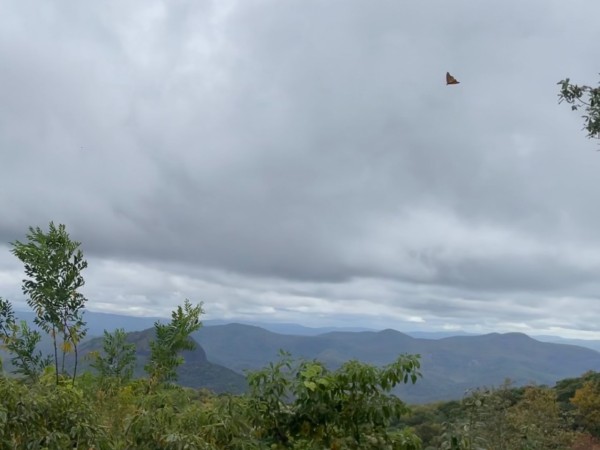
Moving south and into the mountains, Theresa in Canton, North Carolina, reported peak migration on Oct. 7, writing, "Although it was cloudy and 62°F, we counted 409 Monarchs migrating over the Blue Ridge Parkway at the Cherry Cove Overlook between 2 p.m. and 3 p.m."
Migration is not a straightforward process where monarchs all move south in unison. Although we try and follow its leading edge with roosts, monarchs may still be on the move in your area, no matter how far north of the leading edge you might be.
If you're seeing monarchs, let us know by reporting your observations to Journey North!
Fall blooms for monarchs
Available nectar is key to helping monarchs make the trip south. While it's too late to get any new plants in the ground for this season, it's a great time to think about what you want your garden or patio to look like at this time next year.
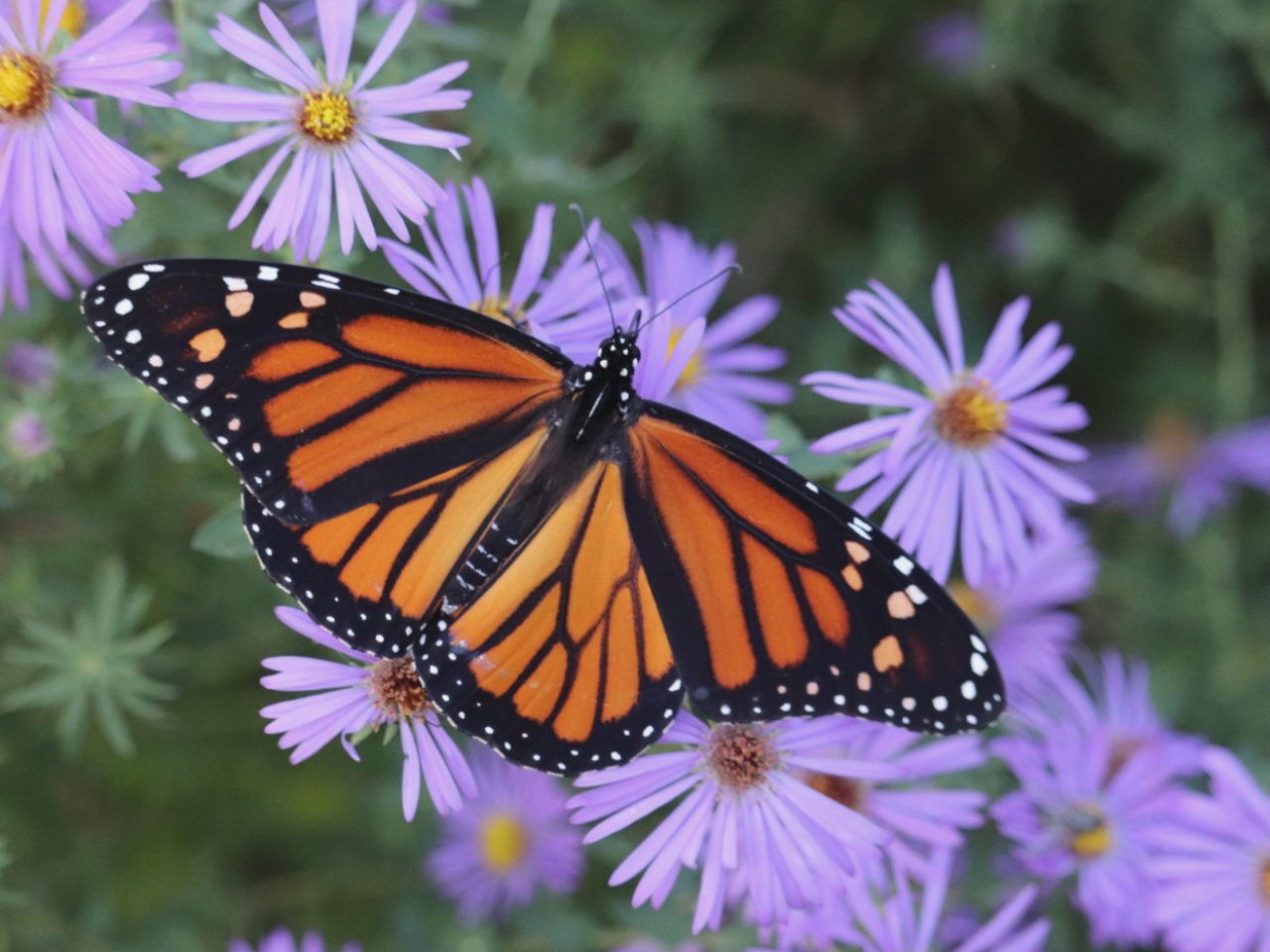
With that in mind, Monarch Joint Venture Habitat Manager Jake Koenig made a list of 10 of his favorite fall blooms, like the asters you see at the top of this article. Check it out here.