The start of migration is here



Monarchs heading south
By Karen Oberhauser
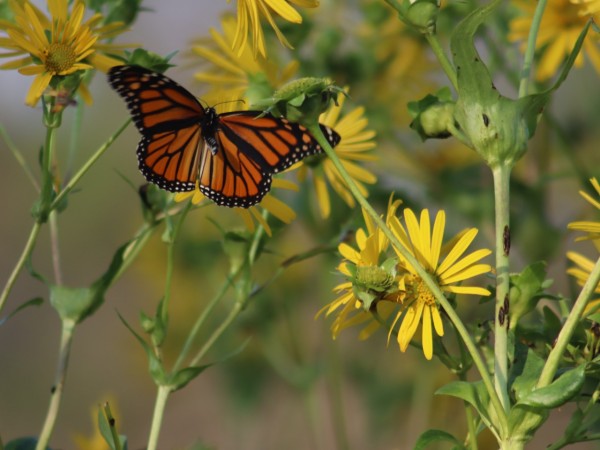
Eastern migratory monarchs that emerge as adults around mid-August or later will be in reproductive diapause and will spend their first few months of “adulthood” flying to their overwintering sites in Mexico. Instead of being ready to mate and lay eggs three to five days after emerging, these individuals will delay reproductive maturity until spring 2026.
This change is triggered by hormonal changes, which were themselves the results of exposure to environmental cues: decreasing daylength, cooler nights, and senescing host plants during development. We’re seeing decreasing numbers of eggs and larvae, and more adults focused on directional flight that will take them toward their winter grounds.
Interestingly, some monarchs that emerge later in the summer but before mid-August, while not in reproductive diapause, also head south. Instead of laying all of their eggs where they developed, and where their offspring would be exposed to cooler conditions and thus slower development, these monarchs move southward as they lay eggs. This “pre-migration migration” has been documented by Monarch Larva Monitoring Project (MLMP) volunteers in the middle and south of the eastern half of the U.S., who see increased egg numbers at the end of the summer.
Journey North volunteers in the north are beginning to document migratory roosts; as of this writing (Aug. 21) there are only four roost reports, in Minnesota, the Upper Peninsula of Michigan, and Southern Ontario, but these reports will pick up over the next few weeks. For an up-to-date picture, visit the monarch fall roost map. The dots with white squares provide amazing photos and every dot includes an observer report.
In Escanaba, Michigan, along the southern edge of Michigan’s Upper Peninsula, Opal reported 300 monarchs on Aug. 20, writing, “We had counted about 250, at morning count. Many left, and by evening roost we had another 200+. We usually have about 5-6 groups come through from now to the 3rd week of September!”
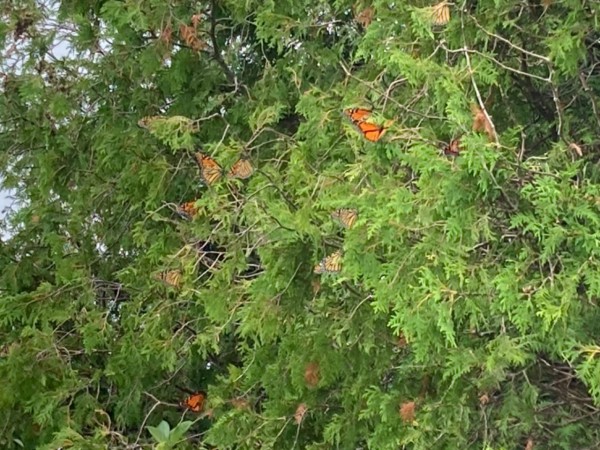
In Chatham, Ontario, Marilou reported on Aug. 21 that monarchs were gathering in a familiar spot.
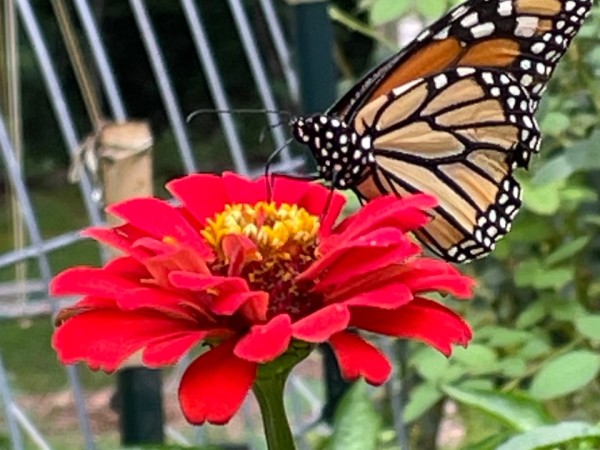
"I saw big numbers of monarchs nectaring on cup plant and Mexican sunflowers all afternoon at my rural home. I decided to check the silver maple trees in the front yard just before sunset," Marilou wrote. "I found this cluster of 8 with many more searching for a place to rest. These trees have been a popular monarch overnight resting place for a number of years now."
How did monarchs fare in 2025?
Monarch numbers continued to be relatively high throughout their main breeding range, at least compared to the last several years, through August. MLMP volunteers have documented strong egg and larva densities, and many people are reporting that they’re seeing many adults.
Promising July “density humps” in most of the Upper Midwest continued into August, with fairly good numbers even past mid-August. All of the eggs and larvae we see after about the end of July will become migratory adults (if they survive), so we should be sending off good numbers to the south.
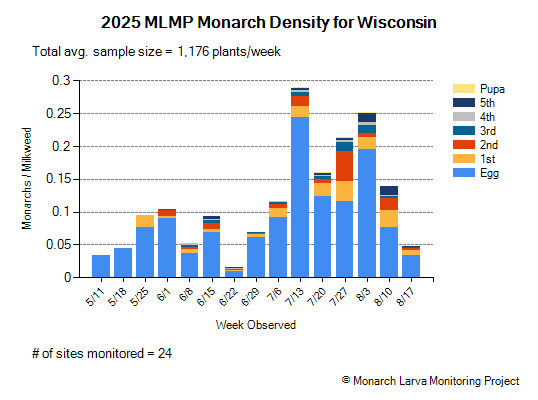
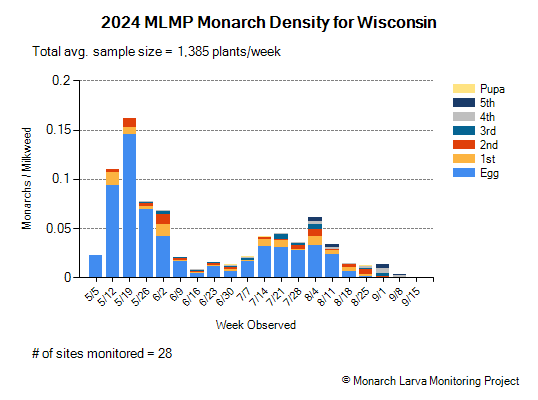
The maps on the right compare 2025 and 2024 egg and larva densities in Wisconsin. Note the large increase in per-plant density of monarch eggs and larvae from June to July in 2025. The 2025 dips during the weeks of June 8 and July 20 reflect rainy conditions, when monarchs weren’t laying many eggs. Note also the bigger increase from the first to the second “humps” in 2025, reflecting more population growth.
For more detailed comparisons across years and in your own state, see the results page on the MLMP website.
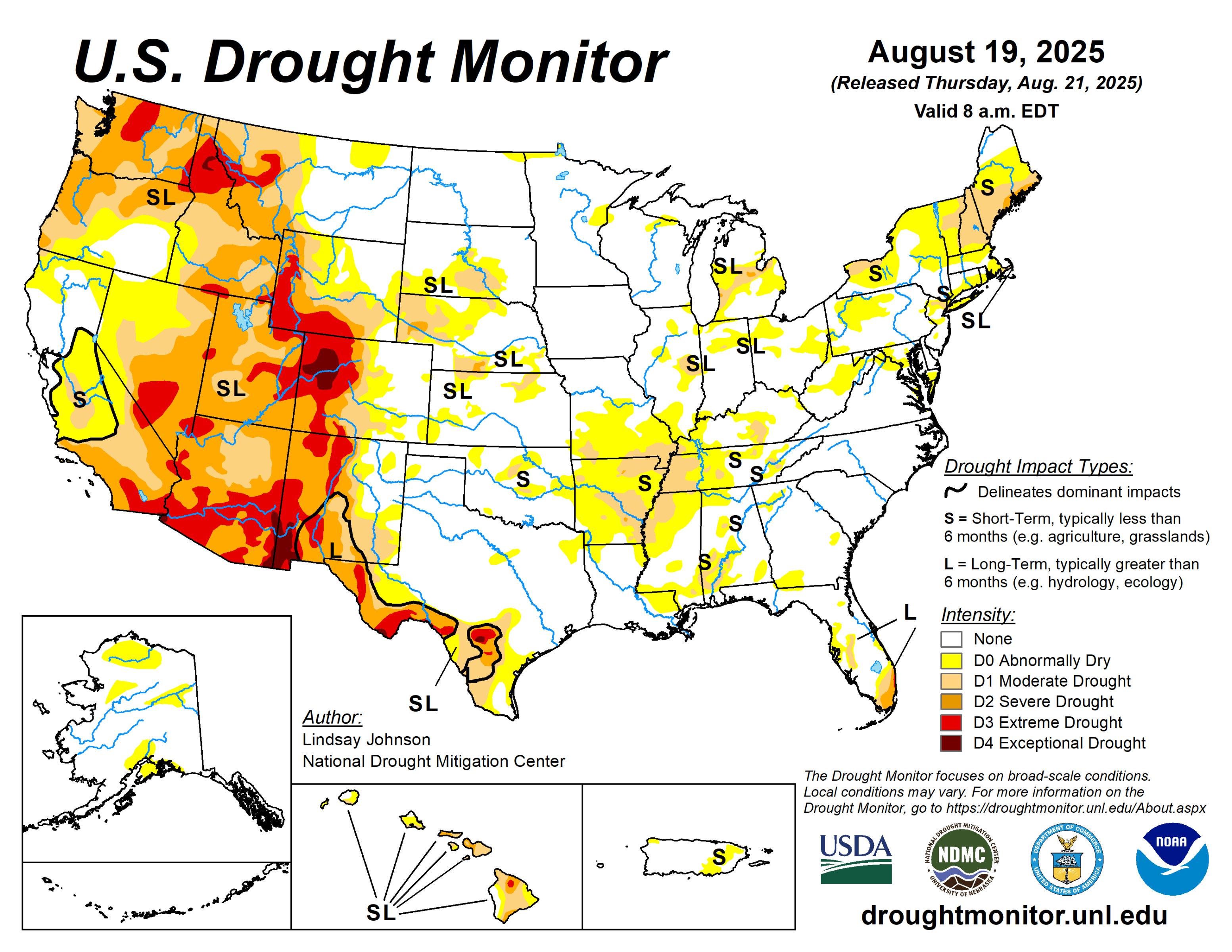
Of course, these migratory adults still need to make it all the way to Mexico, but drought conditions in Texas have lessened (albeit in dramatic and sometimes destructive ways), and monarchs should be able to find the nectar needed to sustain both the migratory flight and their overwintering period.
The map on the right from the U.S. Drought Monitor team shows the current 2025 drought map. For the first time in many years, monarchs have experienced consistently benign conditions throughout their eastern breeding range, and this good luck might continue through the migration. This map bodes well for the eastern migratory population!
Thanks to Journey North (housed by the Monarch Joint Venture) and Monarch Larva Monitoring Project (a collaboration between the Monarch Joint Venture and the UW-Madison Arboretum) volunteers for providing the above data, and the U.S. Drought Monitor team (the National Drought Mitigation Center at the University of Nebraska-Lincoln, the National Oceanic and Atmospheric Administration, and the USDA), who provide important statistics on drought conditions throughout the U.S.
Reports from the field
By Jacob Swanson
Matching what the MLMP numbers show us, many of you have been sharing positive reports and soaking up the last of the summer’s monarchs before they’re on their way south.
Susan in Dodge Center, Minnesota, reported six on Aug. 20, writing, “Checking out my gardens this morning, I felt like I was inside a monarch slow globe. The blazing star is ablaze with them.”
Michelle in Andover, Minnesota, reported 12 monarchs on Aug. 18, writing, “Quite a few butterflies were out today. They were especially attracted to the cup plant flowers in the wetlands.”
In Batavia, Illinois, Frank reported, “Monarchs were everywhere the eye could see in a 20+ acre reclaimed prairie and 10 times more than the last year and back towards 2022 and 2023 numbers. Very hopeful.”
Jmarie reported 11 in Pittsburgh, Pennsylvania on Aug. 19, writing, “I was thrilled to see that 11 Beautiful Monarch Butterflies visited my flowers this week at the same time…Also saw 5 Caterpillars on My Milkweed. Truly Amazing little creatures!”
Breeding continues
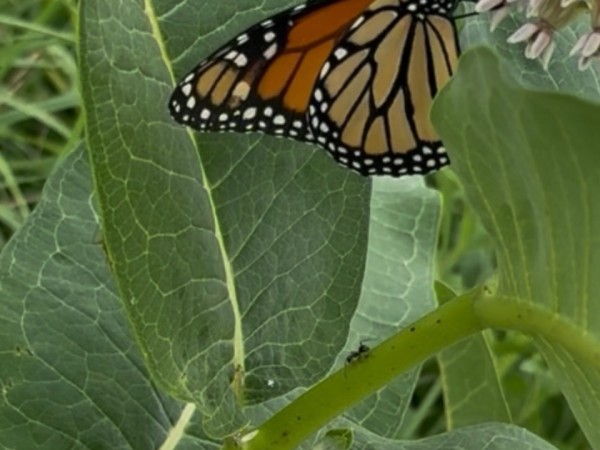
While we may be starting to think about migration, there are still monarchs that are thinking about laying eggs. There’s no distinct boundary separating the breeding and migratory generations, so while some monarchs are in reproductive diapause and gearing up to head south, there will still be monarchs that were part of breeding generations.
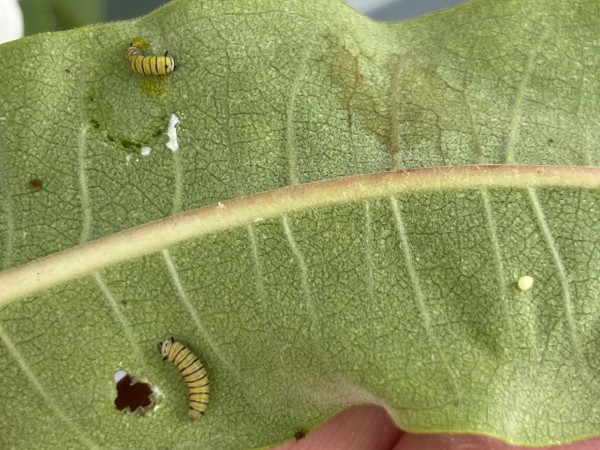
We continue to receive egg and larvae reports. So far this week, we’ve received reports of eggs from the Midwest (Illinois, Iowa, Missouri, Ohio, and Indiana), a few East Coast states (North Carolina, South Carolina, New Jersey, Pennsylvania, and Georgia), and the Appalachian region (Tennessee, West Virginia).
“Though my milkweed garden bed is aging in late August, females still seek it out to lay eggs,” wrote Dena in Rushville, Indiana, on Aug. 18, along with a report of eight monarch eggs.
"Finally saw two tiny cats and egg," wrote Kay in Glasgow, West Virginia, on Aug. 21. "I didn't see any last year! I'm thrilled."
In Laurentian Valley, Ontario, just northwest of Ottawa, Jeremy reported seven caterpillars on Aug. 15, with five on swamp milkweed, one on butterfly weed, and one on common milkweed: "Looking like a promising fall!"
While we haven't had egg reports from further Northeast this week, we have received some reports of larvae still that should be ready to head south soon.
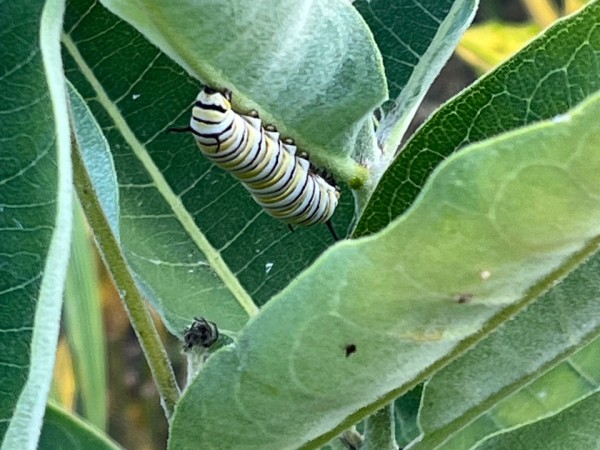
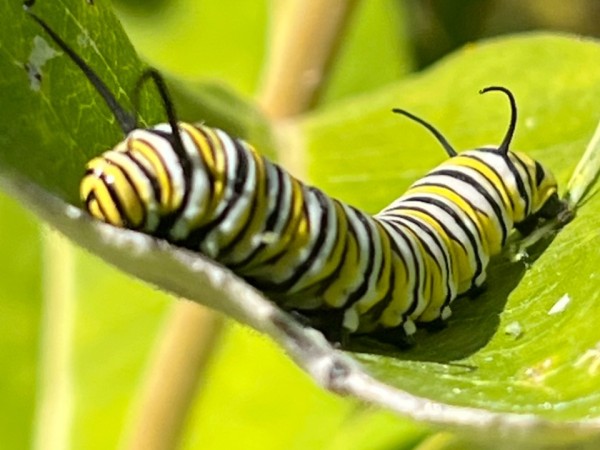
"Late August monarch caterpillar gearing up for migration season," wrote Kate in York, Maine, on Aug. 21, along with a photo of a large caterpillar.
Milkweed in bloom
While most common milkweed plants are covered in pods and past their summer blooms, there is still plenty of blooming milkweed. Earlier this week, we asked our Facebook followers what their milkweed is looking like at this point in the year, and many reported that butterfly weed and swamp milkweed are still blooming.
“The swamp milkweed is blooming!” wrote Jennifer in Lebanon, Illinois on Aug. 16.
Help us track fall migration
Not everyone has seen a lot of monarch activity, but hopefully those of you still waiting for sightings will see some more as they get on the move this fall.
“This is the first time I have seen one,” wrote Angela in Hillsborough, North Carolina, on Aug. 20.
Keep your sightings coming throughout the fall migration, especially if you see fall roosts. Journey North has collected fall roost data for over 20 years, and we need your help again this fall.
We can't always tell when individual monarchs are migrating, but fall roosts like the one Karen mentioned in her update are a good indicator that monarchs are on the move south. Monarchs only migrate by day. At night, migrating monarchs cluster together in trees at night, forming what is called a roost.
A roost may have a handful of butterflies or more than you can count. Sometimes a large roost forms in several adjacent trees. If you see a roost, please report the number of monarchs in the roost to Journey North along with habitat conditions that may indicate what attracted them to the area (e.g., are there nectar sources nearby, are they protected from the wind, etc). Because roosts are dynamic and often reform over multiple nights, please submit a new report for each day you observe the roost.
Monarch roost reports have started, so keep your eyes peeled. Thank you for all of your observations!