Roost reports reach Kansas and Oklahoma, still quiet on the East Coast



Monarchs have made stops in Kansas as migration funnels toward Mexico. Meanwhile, those on the East Coast continue to report monarch adults and caterpillars, but migration news has been quiet.
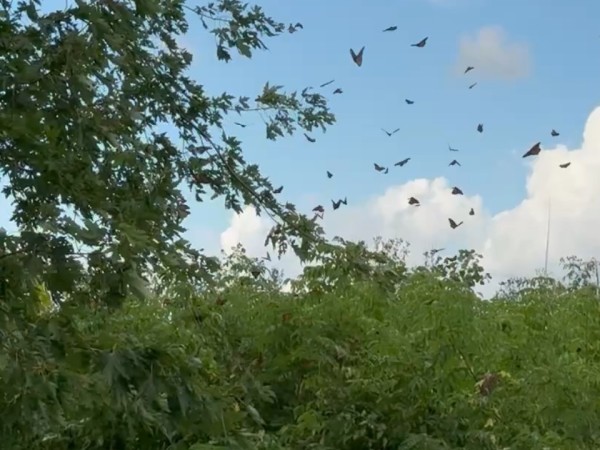
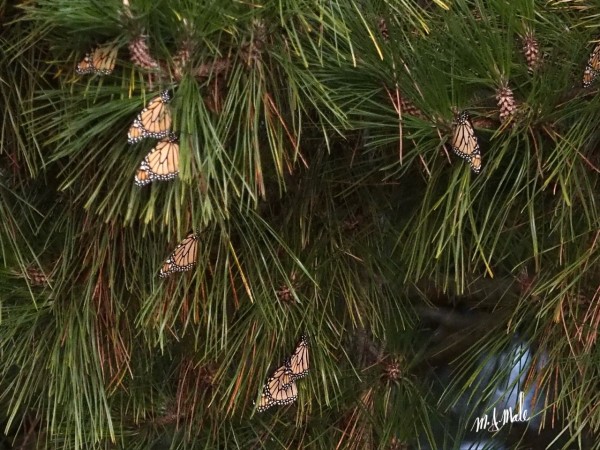
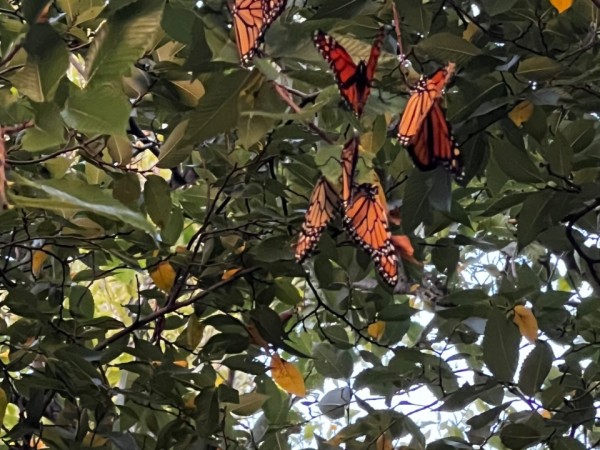
On Sept. 23, Linda in Hesston, Kansas, just north of Wichita, reported a roost of 30 monarchs, writing, “After an inch of rain and overnight thunderstorms, I was curious, so between 8 and 8:30 this morning I checked the hedgerow and counted 30 monarchs roosting on leaves of hedge and other nearby trees, mostly scattered but did find this group of 4 near the patch of zinnias where they have been nectaring.”
Near Manhattan, Kansas, at Konza Prairie Biological Station, Jill estimated over 4,000 monarchs on Sept. 22 while doing a belt transect survey of 25 kilometers long by 60 meters wide.
“I estimate 4,381 monarchs present, minimum,” Jill reported. “They’re nectaring primarily on goldenrod in the bison area.”
A little further west, Pam in Great Bend, Kansas, saw 142 monarchs on Sept. 22, writing, “Monarchs were flying south through an alfalfa field in full bloom, stopping to feed. I counted for one hour as I tagged, in an area of 1 to 2 acres in the large field, so I missed many. I did observe one mating pair. It was around 80 degrees F, with a south wind of 5-9 mph. This was from 12 to 1 p.m. Most were in very good condition, with plump abdomens.”
On Sept. 24, we received our first report of roosting in Oklahoma, just east of the Panhandle, with Brenda in Fargo reporting 40 monarchs.
While Kansas and Oklahoma represent the leading edge of monarch migration through the central United States, there’s plenty still going on further north.
On Sept. 21, Lisa in Lime Springs, Iowa, estimated seeing 5,000 monarchs. In Orleans, Iowa, just past the Minnesota border, John reported 75 monarchs nectaring at one time, the “best single day with activity seen/recorded since this effort began” in 2013.
Here in Madison, Wisconsin, monarchs are definitely still on the move. I spotted a fall roost of about two dozen monarchs over the weekend, as well as seven monarchs flying over the upper deck of Camp Randall as I sat and watched the Wisconsin vs. Maryland football game on Saturday. We don’t have to talk about the result of that game.
What’s going on out East?
We’ve primarily focused on the central U.S. in our last few monarch updates, with most of the migratory activity coming from that direction. Out east, we’ve received just two roost reports: one from Great Gull Island, New York, on Sept. 19 and the other from Moravia, New York, on Sept. 19.
People on the East Coast continue to see monarchs. This week, we’ve received reports from the Southeast all the way up the coast, including Georgia, South Carolina, Maryland, Florida, New York, Virginia, Connecticut, New Hampshire, Pennsylvania, New Jersey, Massachusetts, and Maine.
“There’s hardly any flowers that are blooming now, and this monarch is trying to get something out of this dandelion,” wrote RoseMarie in Jonseport, Maine, on Sept. 23. “I’m hoping it’s going to find something that will sustain it.”
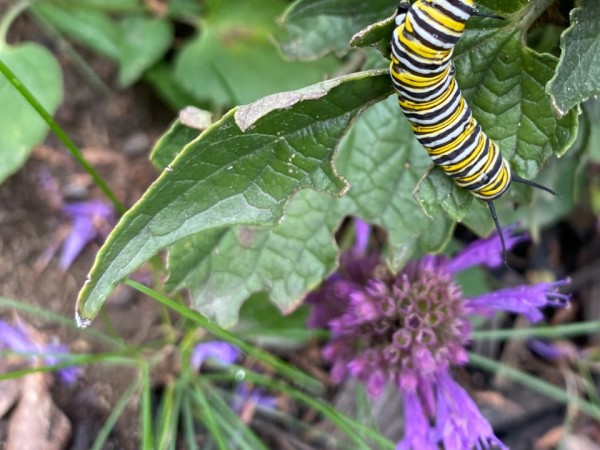
Larvae continue to be spotted, with four reported by Savanna in Enfield, Connecticut, on Sept. 24, Sally in Decatur, Georgia, on Sept. 23.
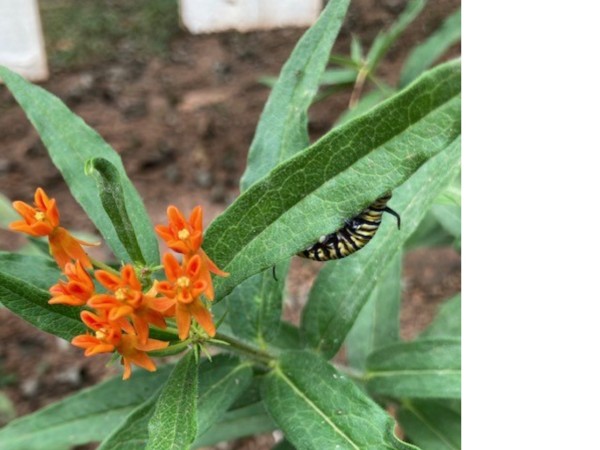
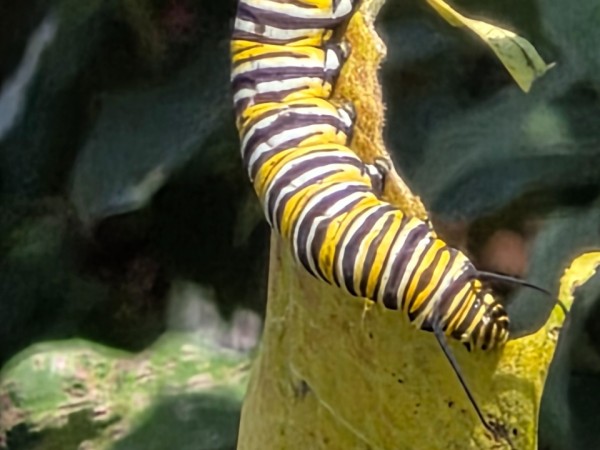
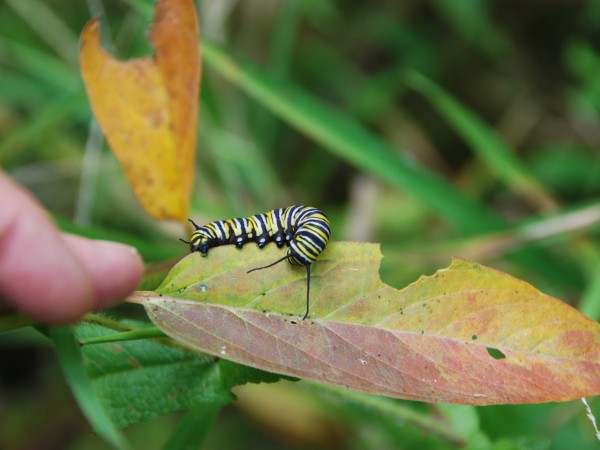
In Floyd, Virginia, Valinda reported a large caterpillar on an old, yellow milkweed leaf, and Donna in Arcade, New York, reported the same on Sept. 22.
“I have been checking my milkweed patches regularly for monarch larvae. I had a late laying monarch butterfly this season, so I hoped I would find a late larva or two. And I did - 3 on this day,” Donna wrote. “Still, I was surprised when I found this well-developed instar 5 larva. Interesting that this mature caterpillar is feasting on an old leaf, turning to red/rust, given there are still green leaves available. I found a smaller, stage 2 or 3 larva on a green leaf on an adjacent flower stalk.
The swamp milkweed has pods, several open and showing off seeds. And, I discovered another instar 5 larva in my common milkweed patch along my pond berm, feasting on a leaf that is still green. Most of the plants sport maturing pods now.”
The northernmost egg reports of the past week come from Wernersville, Pennsylvania, on Sept. 23 and Middletown Township, New Jersey, on Sept. 20. Both were on tropical milkweed.
On Sept. 17, Stephanie in Jersey City, New Jersey, reported 20 eggs in a flower bed of common milkweed still sporting green leaves at Liberty State Park.
We also have plenty of reports from the western U.S. For that, we turn to Gail Morris.
Western monarch update
Migrating monarchs are now moving through the West, and reports show a few breeding monarchs are still busy in milkweed patches. Soon, these breeders will reach the end of their lives, and your reports will tell the story of their offspring.
Recent Sightings
Monarch sighting reports are expanding across the region. Beginning in the Northwest, Paul in Jacksonville, Oregon, saw two monarchs on Sept. 1, writing, “We saw both a male and a female monarch. The female was laying eggs on our milkweed. We found seven of them.”
A week later, Sabrina from Long, Washington, spotted a monarch on Sept. 7: “Just saw the one on a blackberry bush looked healthy.” Two days later, Clodagh from Jerome, Idaho, spotted his first of the season on Sept. 9, writing, “This is the first monarch butterfly we have seen!”
On Sept. 14, Jan in Caldwell, Idaho, reported a “prime female specimen, no visible edge damage on either wing.”
Moving south to the central basins of Utah, Molly saw one monarch in Moab, Utah, on Sept.11: “Storms in the area today, and heavy winds past couple of days.”
Monarch sightings are now being reported further south into Arizona as well. Diana found three monarchs visiting nectar plants at Grand Canyon Village on Sept. 15. Abundant rabbitbrush in flower is a favorite nectar to refuel at this high elevation spot. Multiple monarchs can often be seen feasting throughout the day.
The next day, Catherine from Prescott reported a “healthy female laying eggs on Arizona Milkweed [A. angustifolia] and then nectaring on Gregg’s mist flowers.”
Reports poured in from throughout California this month in increasing numbers. Patty from Grass Valley spotted one on Sept. 5, writing, “I was able to capture this one in a photo. I saw another one two days ago.” Even the inner desert regions in California are reporting monarchs. Lori saw one on Sept. 8, writing, “one came by me - Fluttering by hedges by the pool of our condo community. Three dragonflies were nearby in Rancho Mirage.”
Wynette in Pleasant Grove reported, “We saw 2-3 Monarch adults on 9-14-2025 and 9-15-2025. We have not seen any caterpillars or chrysalids yet this year. This is part of our organic farm's Regenerative Habitat Restoration area with Milkweed and flowering nectar sources from Native Plants.”
The next day, Gerry from Occidental saw three monarchs: “It has been 10 years since any Monarchs visited our garden. Yesterday, Sept. 16, 2025, there were 3 sipping nectar from our big bed of zinnias. I know they love zinnias! I went to our local nursery late in the day to purchase 2 native Milkweed plants. Today they will get planted near the zinnias!”
Looking at our maps. you can see activity in Southern California as well.
Looking for roosts
In the East, monarch roosts are a key harbinger of the fall migration. Thousands of monarchs may cluster together spectacularly in close proximity to spend the nights in trees.
Perhaps not as notable, western monarchs move south and west, gathering in small groups of six to 12 for the night. They nestle on the southeast side of trees at varying heights in anticipation of the warmth of the rising sun in the morning.
Frequently, western roosts are found above or near a fall nectar thicket, a “bed and breakfast” deal, to offer safety for the night and to refuel for the continuation of their journey. Strong winds or inclement weather may force them to move to other tree locations, but they will continue when conditions allow. Look for these little pockets of monarchs this month while the migration is in full swing. We look forward to your reports and photos. Soon, we’ll hear the first reports of larger gatherings of monarchs at the California and Mexico overwintering sites.
Monarch and milkweed sightings needed
Seeing monarchs? Your sightings help us present a balanced and accurate report of where monarchs are appearing each week. Report adult monarchs, eggs, and larvae to Journey North. Your detailed description of what you see can include, but is not limited to, the monarch’s gender and activity. If known, include the type of flowers if they are nectaring or milkweed type if laying eggs. Photos are encouraged and welcomed with all your reports.
Gail Morris is the coordinator of the Southwest Monarch Study (www.swmonarchs.org). She is also a Monarch Watch conservation specialist, the vice president of the Central Arizona Butterfly Association and participates in several western monarch working groups. The Western Monarch News is based on your comments provided to Gail Morris. We hope to increase the number of sightings, photos and comments entered into Journey North. We rely on the volunteers who communicate regularly with Gail and participate in our effort to increase awareness of the population of western monarchs. You can reach her at gail@swmonarchs.org.