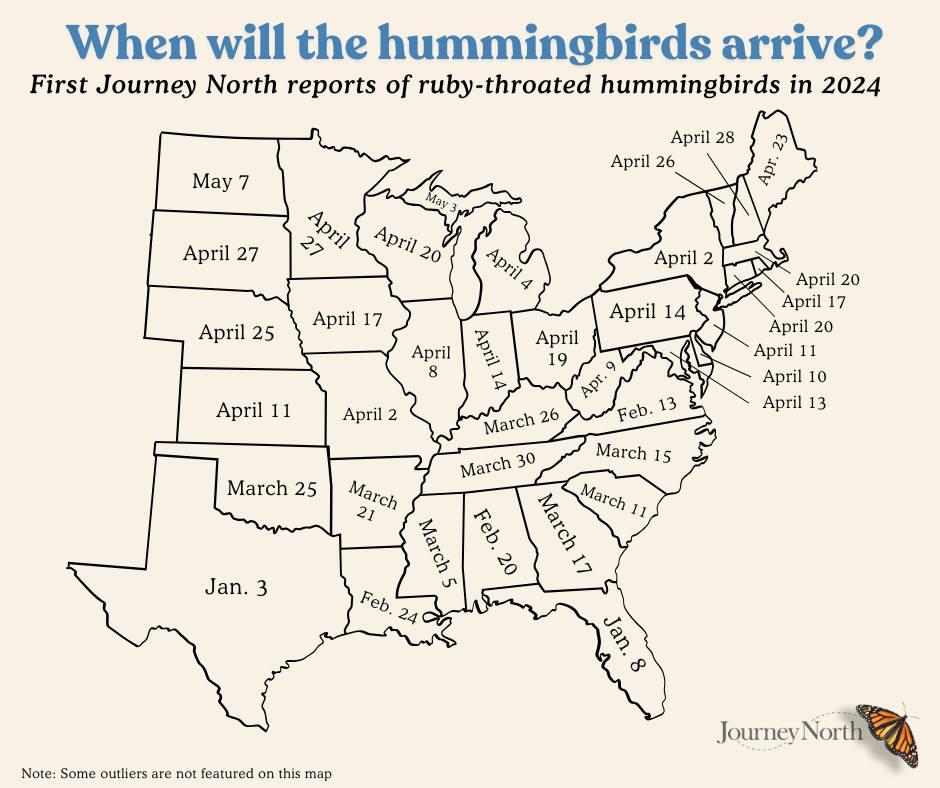
Ruby-throated Hummingbirds fly upward of 1,000 miles twice a year as part of an incredible migratory journey to northern breeding grounds in the United States and Canada and down to their winter residence in Mexico and Central America. Most Ruby-throated Hummingbirds winter between southern Mexico and northern Panama.
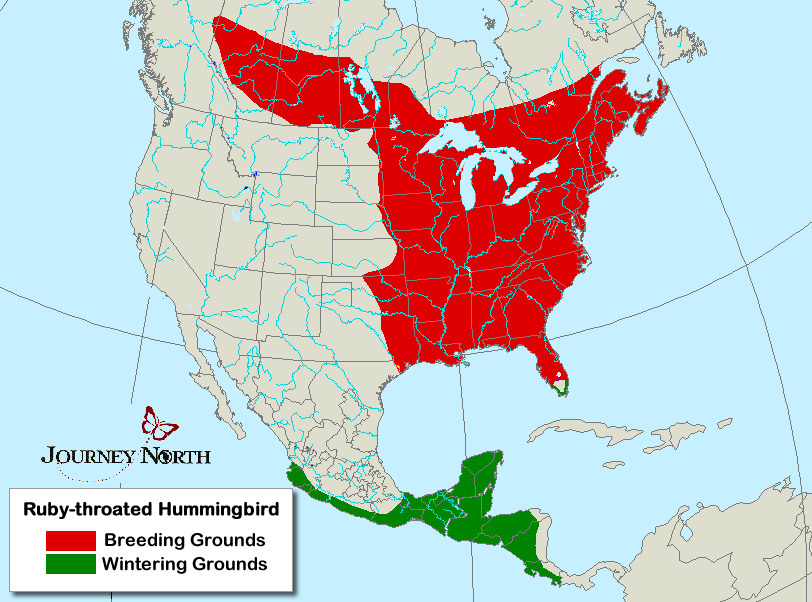
The fall migration
At the end of summer and the beginning of fall, Ruby-throated Hummingbirds start migrating toward their wintering grounds. How quickly will they travel southward?
Based on banding re-encounters, one hummer was noted flying 1,200 miles in 12 days. That means it traveled 100 miles per day. Another hummer flew 335 miles in 7 days, or 48 miles per day. Overall, the average rate of travel is estimated at fewer than 25 miles per day, however.
Think about how far a hummingbird visiting your flowers and feeders today would be a week from now if it traveled 25, 50, or 100 miles per day. Covering this much ground requires a lot of energy, so before migration, hummingbirds feed intensely. Scientists call the pre-migration feeding frenzy hyperphagia. The tiny birds spend more time than usual lapping up nectar and eating insects. For birds about to migrate, food means survival.
Stored Fat
Fat is an ideal fuel for migratory birds. The yellow fat that hummers store from their pre-migration pig-out is rich in energy. Fat is also an easy fuel to store. A surprising amount of fat is deposited in pockets of space in the bird's body and around organs. One area is the wishbone area, near the sternum. Another is along the flanks where the legs attach to the body. Fat stored this way keeps the bird's weight efficiently spread around.
Burning Fat
The stored fat will burn off during migration, giving more than twice the energy per gram than from burning carbohydrates or protein. In addition, twice as much water is produced from burning fat as from burning protein or carbohydrates. The water helps protect the long-distance migrant from dehydration.
How much fuel is in that fat?
Bird scientists have calculated that the fat added through pre-migration feeding frenzies is enough to fuel nonstop flying nearly 600 miles for a typical hummingbird. Ruby-throats that are believed to migrate from southern Florida to Mexico's Yucatan Peninsula could complete their entire migration (about 525 miles) without needing to re-fuel! That's good, since hummingbirds taking that over-water route have no rest stops along the way.
But distance isn't the only factor in fuel consumption; other factors, like weather, can affect the amount of fuel needed for migration. Ruby-throated hummingbirds migrate during peak hurricane season. Strong headwinds in the Gulf can deplete their energy resources and may prove too much for weaker birds that didn't gain quite enough weight. Survivors arrive exhausted and super hungry. The fattest birds have the advantage, as they can use any remaining stored fuel to sustain them until they have more time and energy to search for flowering plants in their winter habitat.
Flying Unescorted
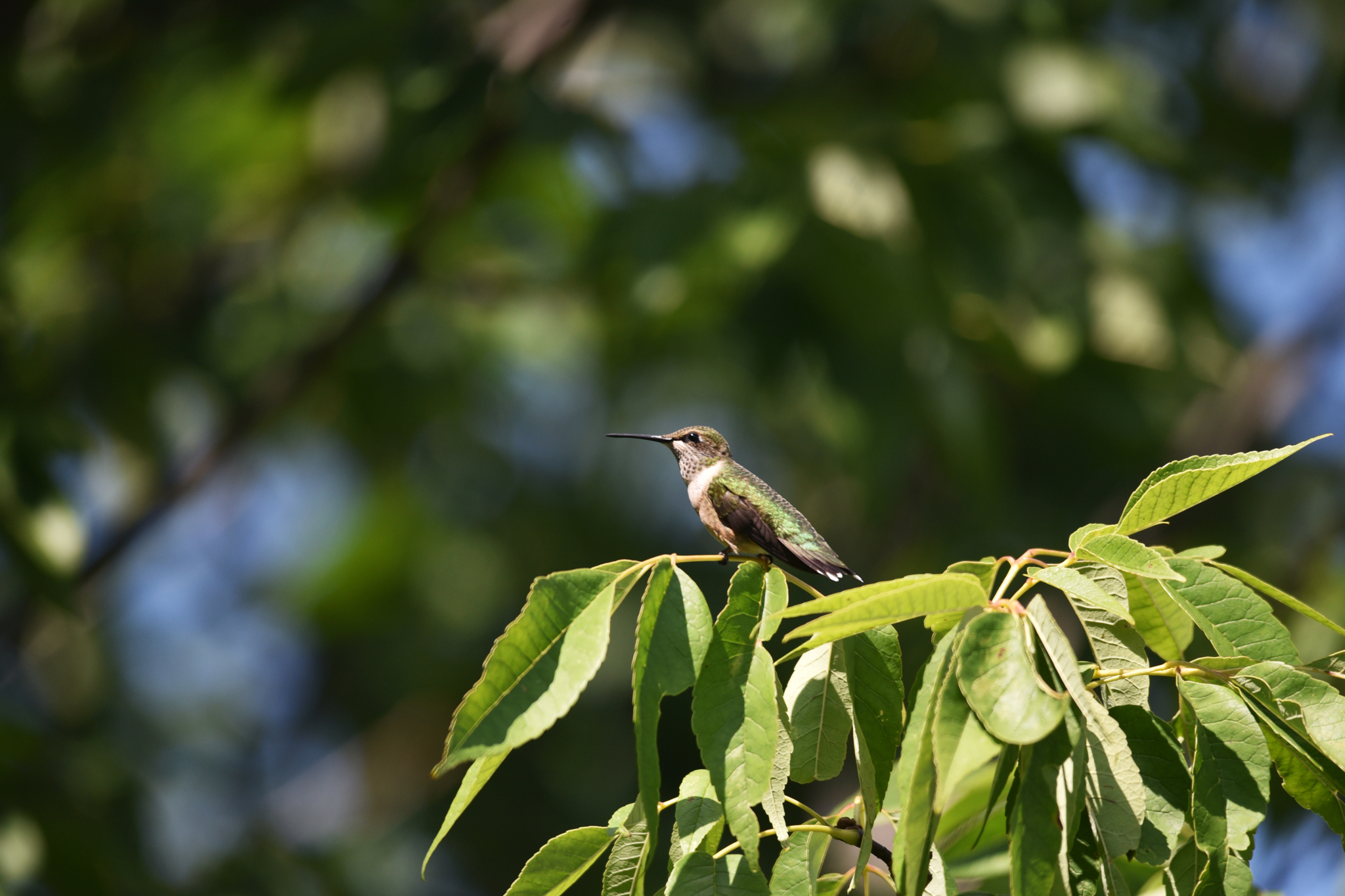
Juvenile hummingbirds do not migrate with a parent. In the fall, they set off on their first migration alone. They instinctively put on weight, fly in a southerly direction, and find a suitable place to spend the winter.
Handling temperature
Feathers as Insulators
When it's cold, a hummer often looks fat because it's fluffing its feathers for extra insulation. It's body temperature is about 105°F (40.5°C). By fluffing its feathers, the hummingbird is able to trap the warm air and protect its body from the surrounding cold air.
Torpor
When fall temperatures are dropping and there is frost in the forecast, how do hummingbirds cope? At night, and when it is too cold or rainy to find food, hummers go into a sleep-like state called torpor. The bird's body temperature drops and their heart rate slows down. This adaptation allows them to keep warm and conserve energy.
During torpor, the tiny bird's body temperature can drop almost 50 degrees. The heart rate may slow from 500 beats per minute to fewer than 50, and breathing may briefly stop. Over the years, some concerned observers have reported seeing a hummingbird still and lifeless, hanging upside down on a branch or feeder. No need for worry, just wait and let the hummer come out of this torpor state at its own pace so that no harm is done.
There is also no need to worry about a hummer falling from a branch during torpor. Its feet get a good grip! When the hummer settles and bends its legs to perch, the stretched tendons of the lower leg flex the toes around the branch and clamp in place. This perching reflex is automatic.
Shivering
In the morning, a hummingbird has to warm up its body the moment it awakes. To do this, the hummer shivers — making its muscles contract and release rapidly. When a hummingbird's body temperature is about 68°F (20°C), it takes about an hour for it to warm up enough for normal activity. During this time, the bird's stomach is empty and shivering is using up stored energy. The hummer is sluggish, groggy, and hungry. As soon as it can, it flies off to eat breakfast.
By Land or By Sea?
Overwintering Ruby-throats begin moving north as early as January, and by the end of February they are at the northern coast of the Yucatan. Some hummers travel by land — skirting around the Gulf of Mexico and following the Texas Coast north. Others migrate over water — 500 miles across the Gulf.
Fueling Up
How do hummers fuel up for migration? They gorge on insects and spiders -- almost doubling their weight in about a week. Layers of fat build up on the hummingbird's back, belly, and throat. A licensed bander gently blew on this hummer's feathers to see the white band of fat on its belly.
Flight Risks
Imagine the risks a tiny hummer can encounter on its 500 mile trip across the Gulf of Mexico. What if strong headwinds slow it down and make the trip take longer than 18-22 hours? What if its fat reserves are depleted before the bird reaches land?
Reaching Land
After doubling its weight, from about 3.25 grams to over 6 grams, a hummer may weigh only 2.5 grams when it reaches land. Finding abundant food and water sources is essential in the coastal habitats along the Gulf. The energy-draining flight burned through the fat reserves and each hummer must replenish immediately in order to survive and continue its journey north.
Arriving First
Hummers reach the coast in late February or early March. Males depart the Yucatan first, followed about 10 days later by the first females. The migration is spread over a three-month period, which prevents a catastrophic weather event from wiping out the population. Are spring habitats ready when the hummers arrive?
When Will Your Hummers Arrive?
Look at wind maps to predict which days hummers will cross the Gulf of Mexico, and then watch the Journey North map to see when and where sightings are reported from the Gulf States. Once in North America, migration proceeds at an average rate of about 20 miles per day, generally following the earliest blooming of flowers hummers prefer. When your hummingbirds arrive they will be eager to eat from your nectar-filled feeders and flowers!