Migration draws near in the West


Breeding monarchs continue to cover western states as their inner call to the fall migration draws near. Eggs and larvae feeding on milkweed across the region are now likely part of the migratory generation and in time, as adults, will launch into their flight, heading south and voraciously consuming fall bloom nectar to fuel their journey. This is a perilous time when a simple change in temperature and weather conditions can help larvae flourish or languish. We’ll see how this tipping point impacts monarchs in the coming weeks.
Recent Sightings
Drought and record-high temperatures covered much of the West in August but monarchs are still making their presence known. Here is a sample of sightings:
Karen reported a female monarch on a dogwood adjacent to milkweed plants in Eugene, Oregon, on August 1. Just across the Oregon-Idaho border in New Plymouth, Idaho, Greg saw one monarch in his yard on August 10.
“Appears to be in very good shape. Landed on the showy milkweed but didn’t stay long," Greg wrote. "Flew off to the west after flying around the yard awhile. I don’t have much in bloom now.”
Michael in Reno, Nevada, saw a monarch visiting sunflowers. “Only one, flew away quickly.” Miriam watched a monarch ovipositing in Hyde Park, Utah, “Female laying eggs in monarch waystation. Have not counted eggs yet, but she is visiting a lot of stems.”
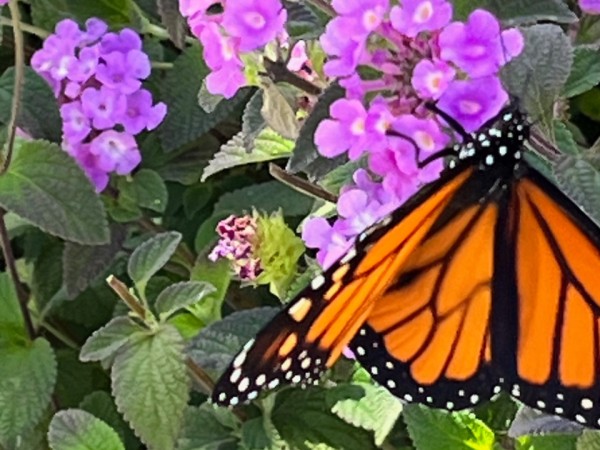
Priscilla in Alameda, California, spotted two monarchs "chasing each other by the Police Station in Alameda," writing, "Unfortunately, I was unable to get a photo of them together. But took several of them feeding on the purple flowers.”
In Camp Verde, Arizona, Sharon spotted her first monarch of August, writing, “Female monarch feeding on Zinnias for a couple of hours. Hot (100 degrees) and breezy. Colors a bit faded.”
Reports from the Field
California
While eyes are on the monarchs of the Northwest and their breeding success to expand the population, monarchs are surprisingly active in California this year. Last month we featured several reports from southern California and monarch spotters continue to report good numbers of adult monarchs visiting yards and pollinator gardens in the region. Many larvae are also reported, a hopeful harbinger of the season if temperatures can remain favorable without a major heat wave. The next 45 days will give us a glimpse into the migratory movement.
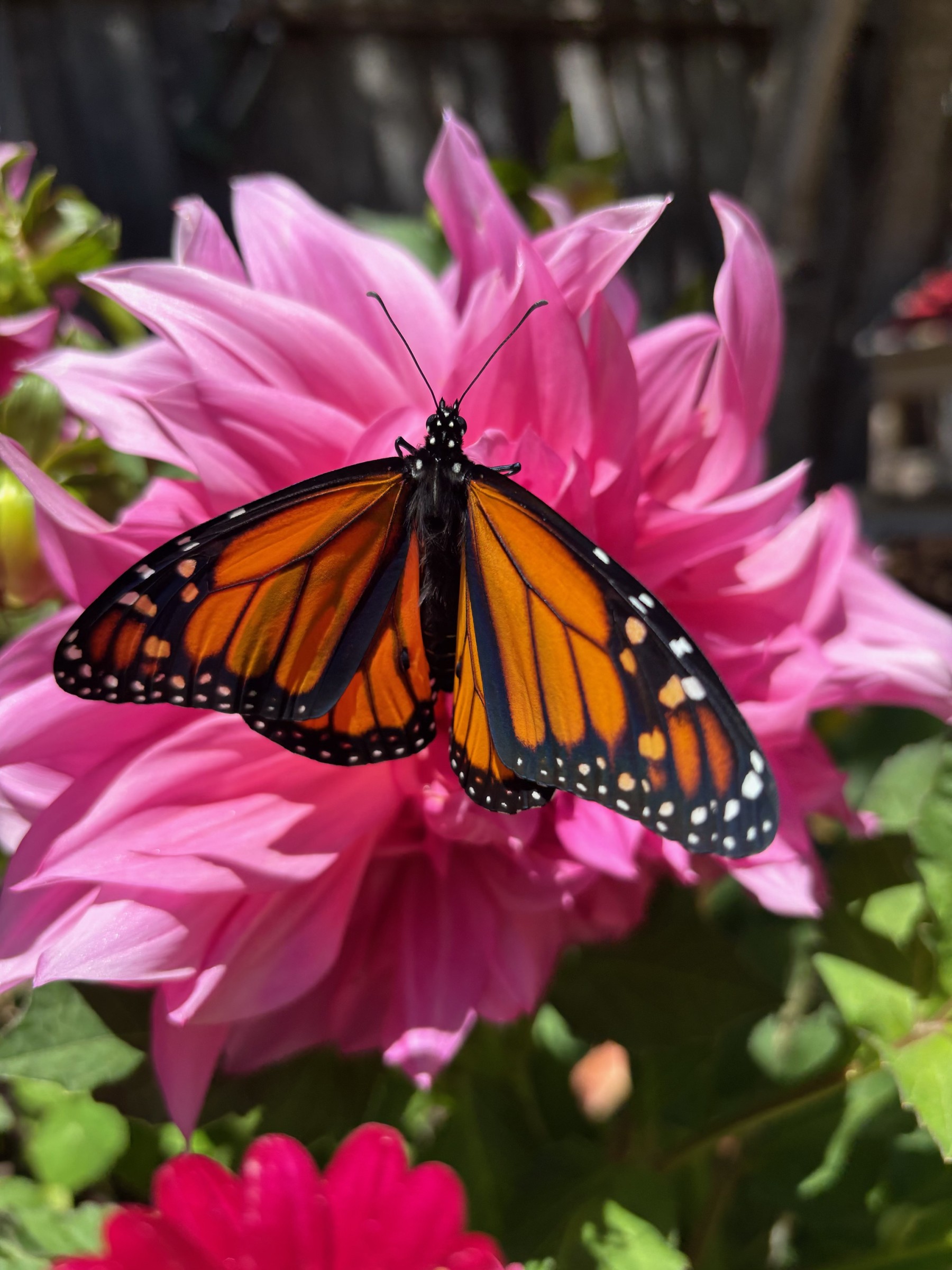
Active breeding in California isn’t limited to southern California. Last week, Diana Magor in Santa Cruz sent in a monarch photo and a reminder of the important connection between children and monarchs. “Here’s a picture of a newly eclosed male monarch from my friend Fransisca at the Preschool where she teaches near UCSC. She has some milkweeds there and a lovely flower garden (including this Dahlia). The kids go bananas when they see monarchs eclose and make sure she knows about it. They are not allowed to touch them. She teaches them all about monarchs and other butterflies in the garden and they get SO excited when they see one! Her age group is 3-4 years old.”
Arizona
Every year we like to take a modified Pollard walk through several monarch breeding areas to gauge the monarch population. After two years of mostly “no shows,” this year there are several indications of modest monarch numbers at the Grand Canyon, Flagstaff, the White Mountains (particularly Springerville), and more. A lot will depend on the temperatures the next 30 days for the monarch immatures still in the fields if they can successfully complete their life cycle without record-high temperatures. Earlier, the National Weather Service was hopeful we would have a good summer monsoon season with rains replenishing the dry land, but it has been extraordinarily hot and dry. There is rain in the forecast this week. Hopefully a calming rain will soothe our parched land and bring flowers for the migration.
Monarch and milkweed sightings needed!
Seeing monarchs? Your sightings to help us present a balanced and accurate report of where monarchs are appearing each week. Report adult monarchs, eggs, and larvae to Journey North. Your detailed description of what you see can include, but is not limited to, the monarch’s gender and activity. If known, include the type of flowers if they are nectaring or milkweed type if laying eggs. Photos are encouraged and welcomed with all your reports.
Gail Morris is the coordinator of the Southwest Monarch Study (www.swmonarchs.org). She is also a Monarch Watch conservation specialist, the vice president of the Central Arizona Butterfly Association and participates in several western monarch working groups. The Western Monarch News is based on comments provided to Gail Morris. We hope to increase the number of sightings and therefore photos and comments entered into Journey North. We rely on the volunteers who communicate regularly with Gail and who agree to participate in our effort to increase awareness of the population of western Monarchs. You can reach her at gail@swmonarchs.org
Thank you for all of your Blitz reports
Speaking of monarch and milkweed sightings, we owe a big thanks to everyone who submitted reports to Journey North as part of the International Monarch Monitoring Blitz. With your participation, both the number of participants and the number of reports submitted to Journey North were up considerably over last year.
We'll have some numbers to share once the data is compiled by our Blitz partners, but in the meantime, thank you for making this year's Blitz a success. Your energy and enthusiasm throughout the 10-day monitoring period was notable, and we hope we're able to continue that excitement into the fall migration.
If you were a first-time Blitz participant, we'd love to have you stick around. You can report sightings of monarchs and milkweed at any point of the year. We're excited to hear from you.
Upcoming free event with Dr. Karen Oberhauser
We also want to alert readers of a free, online presentation by Dr. Karen Oberhauser as part of the Mighty Migrations Series.
On Wednesday, August 20, 2025, from 7 p.m. to 8:30 p.m., Karen will describe the amazing biology of migratory monarchs, how we can use data collected by scientists and public to understand what is driving monarch numbers, and what we can do with that information. The take-home message will be how we can address species conservation—in our own gardens and beyond—in the face of climate and other human-driven changes.
Karen describes her research field, conservation biology, as the science of hope. The challenges we face as we work to preserve biodiversity are steep, but our collective concern for monarchs and, by extension, the thousands of species with which they share habitats can provide a glimmer of hope in a complicated and rapidly-changing world.
Anyone, anywhere is welcome to join in this free webinar to learn more about the incredible monarch butterfly.
The Mighty Migrations Series is co-hosted by Southern Wisconsin Bird Alliance, SOS Save Our Songbirds, and the Natural Resources Foundation of Wisconsin. The Wisconsin Monarch Collaborative and Journey North are also co-sponsoring the monarch presentation.