Western Monarch Count begins, Monarch roosts in Mexico



Eastern monarch update
By Jacob Swanson, Journey North program coordinator
The first monarch roosts in Mexico have been reported, with our friends at Correo Real passing along a couple of reports just across the Texas border.
Here is part of their recent report, translated into English:
"On Sunday afternoon, Oct. 19, two roosts were recorded in northern Coahuila: one near La Amistad Dam, Coahuila, with more than 20 monarchs, another at a cattle ranch in the municipality of Guerrero, Coahuila, where six butterflies were observed roosting on a huisache tree. Today, at this same site, more than 90 butterflies were counted beginning to establish their nighttime roost."
These monarchs still have a lot of miles to cover before they reach overwintering sites, but they're getting closer. Even monarchs in Guerrero, some of the closest to overwintering sites that we're aware of, will still have more than 500 miles still to go.
Soon, we'll have updates from Estela Romero as monarchs begin to arrive at these overwintering sites. Follow Correo Real on Facebook or Instagram to keep up with monarchs as they migrate through Mexico. We'll pass along any future reports we receive as well, but if you're looking for real-time updates, Correo Real is a great resource.
Meanwhile, in the U.S., it's been a busy week of sightings in Oklahoma and Texas.
On Oct. 17 and 18, we received numerous reports from Oklahoma City. On the 18th, Carrie estimated seeing 1,000 monarchs, writing, "second night in a row for fall roosts at my home!"
In the Abilene area, we received several reports earlier in the week. Jean in Abilene estimated seeing 2,500 monarchs on Oct. 16, writing, "I believe there were more monarchs than a week ago, roosting in 12-15 pecan, oak, and hackberry trees. At least 1,000 in each of the 2 pecan trees and hundreds in the other trees. It was in the mid-80s today and calm. The monarchs are nectaring along with queens on Gregg’s blue mist, Turk's cap, salvias, and fall asters."
"Counted 400 at 7 p.m. on the north side of pecan trees at the north end of Ozona Town Square Municipal Park," James in Ozona, Texas, a little further south, wrote. "Winds were from the south and they had been roosting here in smaller numbers since last week. On the next day (Oct. 21), winds were from the north and the roost emptied out. Ozona locals say they roost here regularly."
Monarchs' progress will depend, in part, on these winds that allow them to cover thousands of miles over the course of their migration. While many are getting closer, some still have a long way to go.
News from the North
This week in the East, we've received monarch reports from New Hampshire and Maine. In New Hampshire, we got one from Hampton Falls on Oct. 22, another in Nashua (latitude 42.8) on the 21st, and one in Bradford on the 19th. A West Paris, Maine sighting (latitude 44.3) on Oct. 19 was our northernmost report this week.
"Surprised to see this monarch on my lantana plant today," Debby in Nashua wrote.
Moving to the Midwest, we got a report from Glendale, Wisconsin, on Oct. 20, with Steven reporting a monarch on a zinnia before flying south to land in a silver maple tree.
Just north of Point Pelee National Park, Ontario, generally a reliable place to see monarchs just before they cross Lake Erie into the United States, Gary reported 17 monarchs still working their way south on Oct. 20.
"In good wing condition and color (except for one individual)," Gary wrote. "Suspected that they will remain to roost in the silver maples in the fenced-in area. In the meantime, this is an excellent location to remain while nectar source Red Clover remains in flower."
From these northern locations down to the border of Mexico, monarchs are still being spotted as we approach the end of October, although the larger numbers are coming from the south, as expected.
If you see a monarch, even if it's only one or two, report your observation here!
Where are larvae continuing?
It's been mostly quiet on the larvae front. Since the start of the week, we've only received reports from four states: Texas, Tennessee, Florida, and Oklahoma. Going back a few more days, however, we received reports as far north as Pennsylvania and Ohio.
Cathy in Wernersville, Pennsylvania, reported a third-instar caterpillar on tropical milkweed on Oct. 18 and Lou Ann in Pataskala, Ohio, reported one on honey-vine milkweed on Oct. 17.
It will likely be too late for these monarchs to make the migration, but they will still contribute to the ecosystem in other ways, such as providing food for other organisms as we approach winter.
In ideal conditions, it takes between one and two weeks in a chrysalis, plus whatever time each of these caterpillars has left in the larval stage. Ideal conditions are not expected, and development takes longer at colder temperatures, which will work against these monarchs as well.
We haven't received any reports of eggs since Oct. 15, which is good news. Monarchs breeding and laying eggs now won't complete their migration, as they're not in reproductive diapause, which enables monarchs to live all the way through the winter.
Western monarch update
By Gail Morris, Southwest Monarch Study coordinator
The migration window for monarchs is closing as we reach the final days of October and monarchs hurry on their way. First monarchs are appearing at the California overwintering sites as others cross the border into Mexico.
Recent Sightings
Martina in Ogden, Utah, reported two monarchs on Oct. 13, visiting "the last blooms of the Cosmos and Zinnias” on a sunny day. In Grand Junction, Colorado, Jona saw one monarch on Oct. 17 "feeding on the Maximillian sunflowers."
As the migration increases in Arizona, Catherine in Prescott saw one monarch on Oct. 18: “Female in excellent condition nectaring all day on tithonia, Greg’s mist flowers, and butterfly bush.”
Della in Phoenix found one monarch on Oct. 11, writing, “Firstm monarch of the season, one male arrived at 3:50 p.m. on a rainy Saturday, flying in circles around the ageratum."
Dorothee in Lake Havasu reported two monarchs on Oct. 9. In previous years, Dorothee found many more monarchs at this location at this time of year. Linda in Tucson found one monarch on Oct. 15.
Monarchs in California are moving closer to the overwintering sites. Maria in Woodland saw one on Oct. 11, writing, “Another beautiful male came to my backyard four days after the last one I spotted on the 7th of this month. It arrived around 4:45 p.m. and stayed for 15 minutes, feeding mostly on butterfly bush flowers... The butterfly would land briefly on the Cape Town orange tecomaria that is next to the butterfly bush."
Cynthia in Stockton, California saw one monarch on Oct. 12, although it appears this monarch's story didn't end at the overwintering sites, as Cynthia wrote, “This beautiful female fed on our front yard butterfly bush for a few hours earlier today. Sadly, in the late afternoon, my husband found a single monarch wing lying on our sidewalk. I do not know what happened, but there was an active scrub jay in our yard the same afternoon. I checked my bush carefully for praying mantis, but saw none. Sending this report makes me sad.”
Reports from the Field
Diana Magor: Santa Cruz, California
Diana shared two reports of monarch counts in Santa Cruz from Oct. 10/11 and October 17.
October 10/11, 2025
Elizabeth (Beth) Bell and I conducted monarch counts at Natural Bridges and Lighthouse Field in Santa Cruz this week. Here are the results:
Natural Bridges: Thursday, Oct. 9, 2025, 11:16, Sunny, 67°, calm. Beth’s count: 31, no clusters. The ivy flowers are just starting to open, so very few were nectaring or flying over ivy flowers. Most were individuals roosting in shady spots on the east side of the gorge.
Lighthouse Field: Friday, Oct. 10, 2025. 8:30-10:00. Sunny, 59°, light westerly breeze.
East side:
11 on an east side eucalyptus, all males that could be identified
Three females on an east side Monterey cypress (tree 15)
West side eucalyptus:
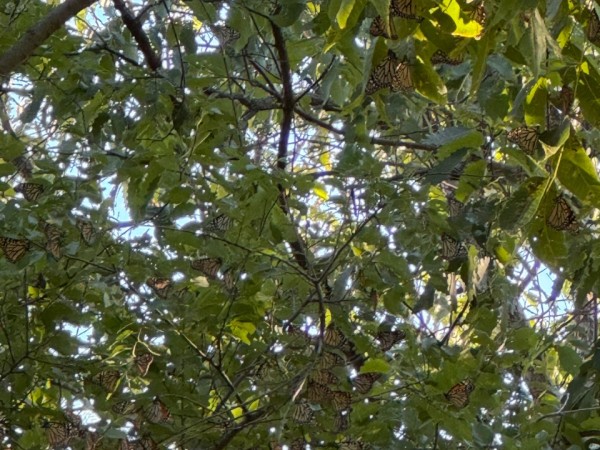
One female, approximately 24 males, including one cluster of 16, mostly or all males, 10-15 feet up. (one flew east before the attached photo on the right. The 15th monarch is at the bottom of the photo.)
Center of grove:
One female on the trunk of small eucalyptus, two males on cypress tree 7, about 50 feet up.
October 17, 2025
At our monarch count at Lighthouse Field on Oct. 17, most of us found over 200, and Tara Johnson had the highest count after checking her photos, of 239 monarchs, more than double the two earlier counts I did of 93 on Oct. 14 and 15.
I surveyed the grove the morning of, and the morning after the rainstorm on Oct. 14, and the number was essentially the same.
Beth Bell and John Dayton surveyed Natural Bridges State Beach on Oct. 16 and found about the same number as we found at Lighthouse Field (197) on that day. They looked at Moran Lake earlier and found only a handful there.
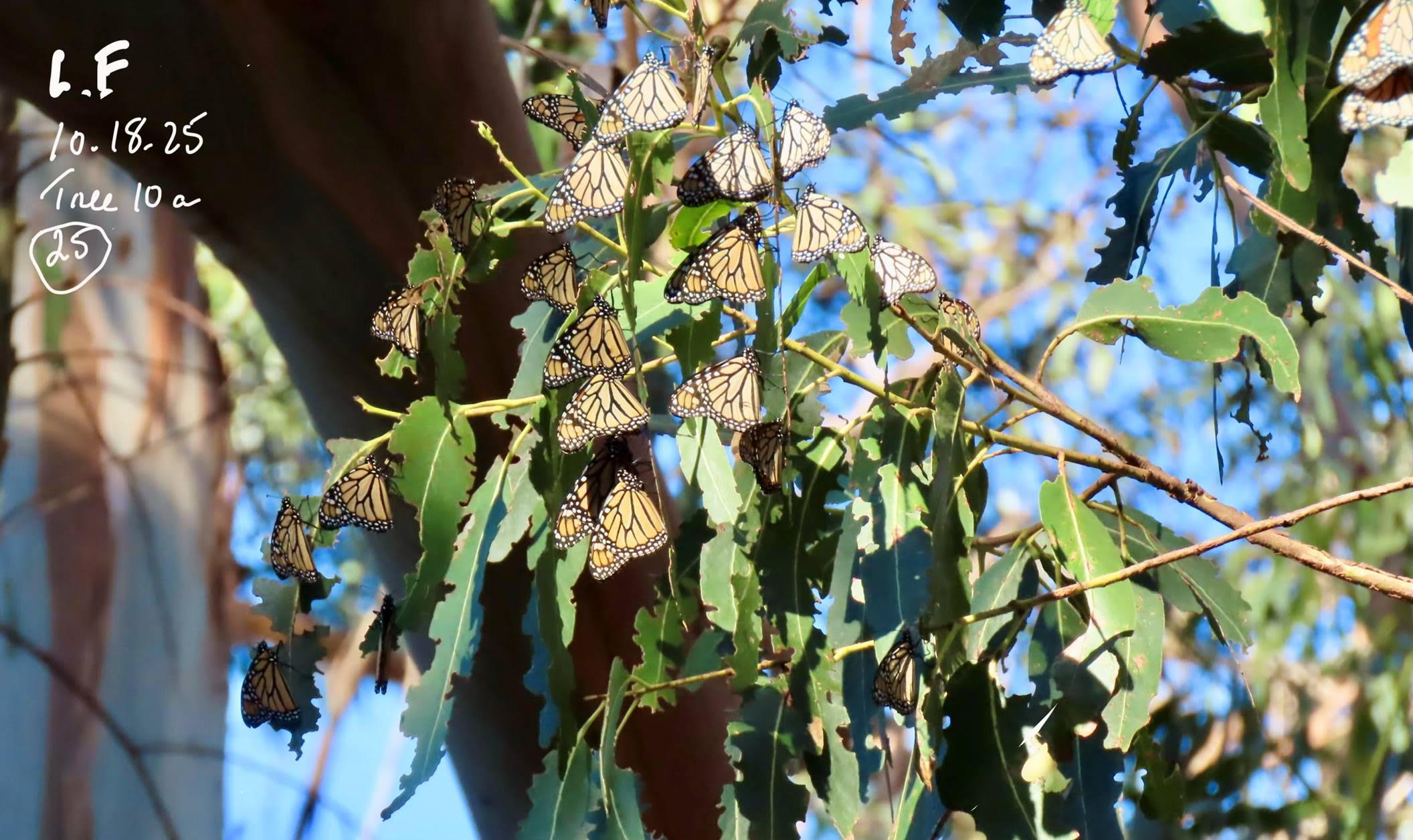
The numbers at Lighthouse Field are increasing steadily. There are several clusters now, especially inside the cool, dark western eucalyptus grove, where there were 49 monarchs staying mostly quiet in loose clusters plus a few loners, from 12 to 20 feet above ground.
Stephanie Turcotte Edenholm: Pacific Grove, California
We conducted our first official monarch count in the Pacific Grove habitat this morning, Oct. 17. We forgot just how cool it can be inside the grove. It was 50°F with ENE 7-mph winds and gusts up to 11 mph. We had to search pretty hard to find them, and we found five, mostly where you’d expect, high in the trees where the sun was. There were no clusters. Only in one cypress along the hotel path in the east were there two together.
Last season, our first count was on Oct. 25 and we had five to start off the season off, as well. There were reports of 20 monarchs in the nectar beds the previous day. Yesterday, I also noted four monarchs flying west and northwest along the coast, away from the grove.
“From what I have observed over the last week, it seems the monarchs that are in the grove are just utilizing the nectar beds to refuel on their way to other sites. The wind gaps in the grove are pretty significant. You can now stand on the footpath in the southern end of the grove and see the ocean!
Stay tuned.
Monarch sightings needed
Thank you to Diana Magor and Stephanie Turcotte Edenholm for your reports, as well as everyone submitting reports to Journey North.
Are you seeing monarchs? Your sightings help us present a balanced and accurate report of where monarchs are appearing each week. Report adult monarchs, eggs, and larvae to Journey North. Your detailed description of what you see can include, but is not limited to, the monarch’s gender and activity. If known, include the type of flowers if they are nectaring or milkweed type if laying eggs. Photos are encouraged and welcomed with all your reports.
Gail Morris is the coordinator of the Southwest Monarch Study (www.swmonarchs.org). She is also a Monarch Watch conservation specialist, the vice president of the Central Arizona Butterfly Association, and participates in several western monarch working groups. The “Western Monarch News” is based on your comments provided to Gail Morris. We hope to increase the number of sightings, photos, and comments entered into Journey North. We rely on the volunteers who communicate regularly with Gail and participate in our effort to increase awareness of the population of western monarchs. You can reach her at gail@swmonarchs.org