

Journey North isn’t just a fun way to visualize the migration of monarchs, hummingbirds, and your other favorite North American migratory species. Your contributions have real, significant value to scientists studying the conservation of these species.
In 2025, researchers in Canada published an article titled “Mapping monarch seasonal breeding patterns in Eastern North America to inform mowing strategies for roadsides and other rights-of-ways” in the Journal of Insect Conservation.
This study used community science data, including Journey North, “to define breeding patterns and timing of monarch breeding throughout the United States and Canada,” with the goal of informing management and mowing decisions.
It’s always nice to see examples of how all of your contributions can impact conservation in positive ways. If only a few rights-of-way managers adjust their timing to benefit monarchs, your contributions will have made a tangible difference.
Thank you for all of your observations to Journey North over the years, and thank you to researcher Vincent Fyson for sharing some information about how Journey North data was used for this article.
Using Journey North observations to inform management decisions
By Vincent K. Fyson, Canadian Wildlife Federation
It can be hard to imagine how a single observation of a monarch butterfly or another organism can be critical for advancing science, but that’s the power of a community.
The thousands of observations submitted to community science platforms like Journey North have enabled a vast body of research that, not long ago, would have required an immense and costly undertaking, with years of effort, or would not have been possible at all. Sometimes it’s nice to see how your observations are used and make a difference, so I’d like to offer the perspective from the user of community science data and explain how your observations have helped advance monarch butterfly conservation.
The Canadian Wildlife Federation has worked to restore thousands of hectares of meadow habitat with a primary goal of providing breeding and nectaring habitat for monarch butterflies. Much of the habitat we have restored is situated in the working landscape; electrical transmission corridors, roadsides, or other lands that require regular maintenance and are often full of invasives, maintained as turf grasses, or poor-quality insect habitat for a variety of other reasons. These lands are frequently compatible with high-quality meadow habitat but still require regular maintenance, such as mowing, to ensure shrubs and trees don’t encroach. When habitat was restored with monarch conservation in mind, many land managers would raise the question of when maintenance, such as mowing, can be done to ensure minimal harm to monarchs. We wanted a data-driven answer to that question, and that’s where the power of community science shone.
We were able to gather over a hundred thousand observations of monarch breeding evidence, which is to say observations of monarch eggs, larvae, or pupae, from Journey North and other community science databases. Those observations allowed us to determine the start and end dates of the breeding season for the entire breeding range of the eastern migratory monarch, a task that would not have been possible for us otherwise. The results, beyond being useful for land managers and monarch conservation work, also offered interesting insights into monarch breeding timing. For example, we were able to map the locations where monarchs breed in the spring and the fall, but not in the summer, as well as the locations where monarch breeding is restricted to the summer months. We were also able to see that monarchs start breeding about a month later in the northeast of their range than in the northwest, but end breeding about a month earlier in the northwest than in the northeast.
Thanks to community science, we now have a resource we can provide to our partners that can help them identify the dates outside of which they can mow or do other maintenance activities while causing minimal direct harm to monarchs. If you’re interested in learning more about our work using Journey North data, you can find the publication here.
The latest from Mexico’s overwintering sites
By Estela Romero
How to describe the air gently blowing in the forest? The delicate mist drops shining on the leaves of plants and trees at sunrise? The capricious cluster shapes our spectacular monarchs form on their oyamel fir branches at their hibernating spots?
The New Year opens with much milder climate conditions than we had by Christmas Day. Sunny and warm days by now welcome the unstoppable peak of local and international visitors, increasing from now to March.
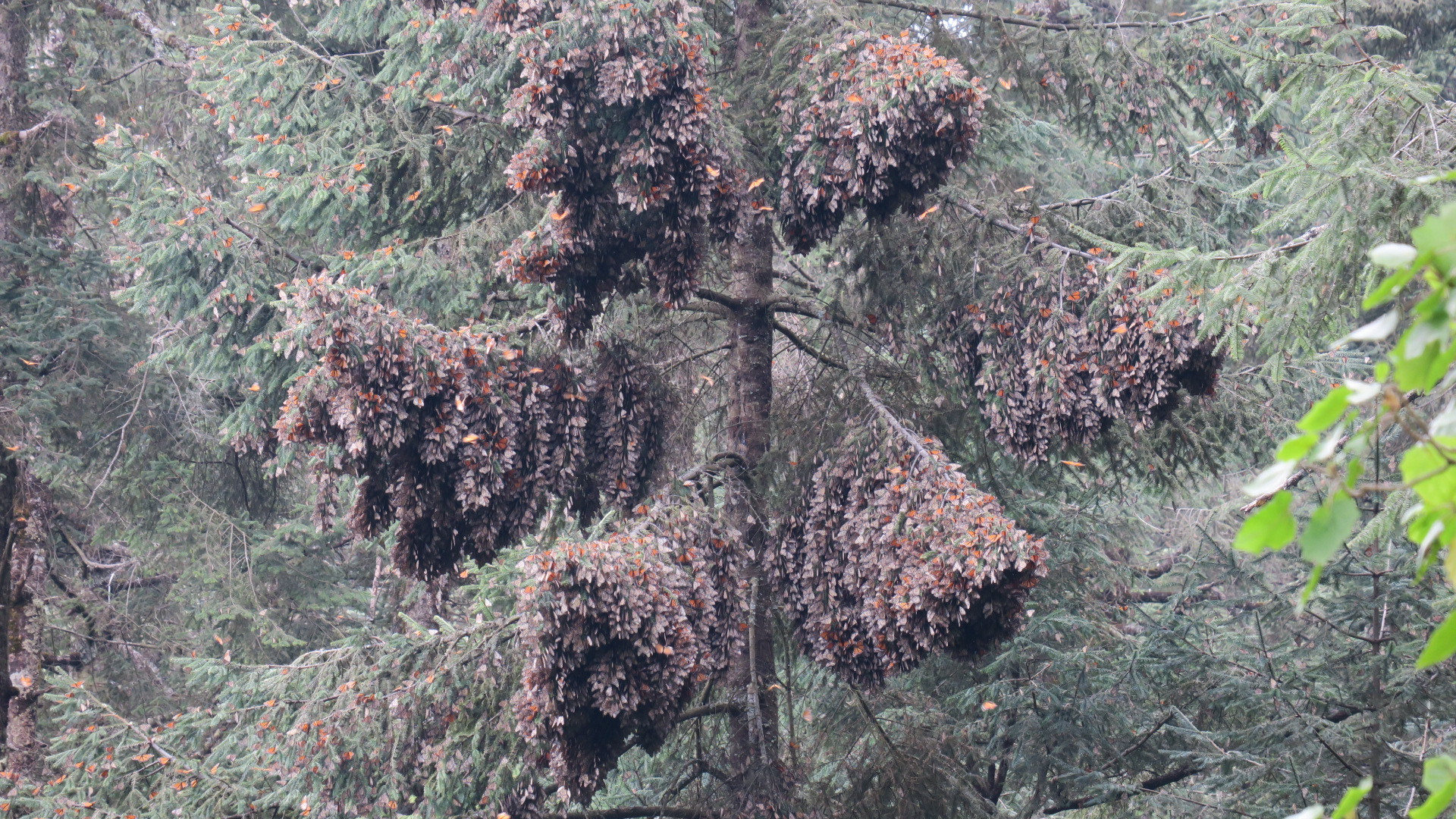
Sierra Chincua Sanctuary remains in its very same location, getting beautifully higher in population, acquiring now an indescribable beauty in the way it concentrates and forms incredible cluster shapes.
El Rosario Sanctuary has just moved a few hundred meters south to another of its first traditional arrival spots called “Los Horcones”. 19.5952 -100.2617, between gaining population, but re-accommodating in concentration too, which shall considerably change the impression of the site each time.
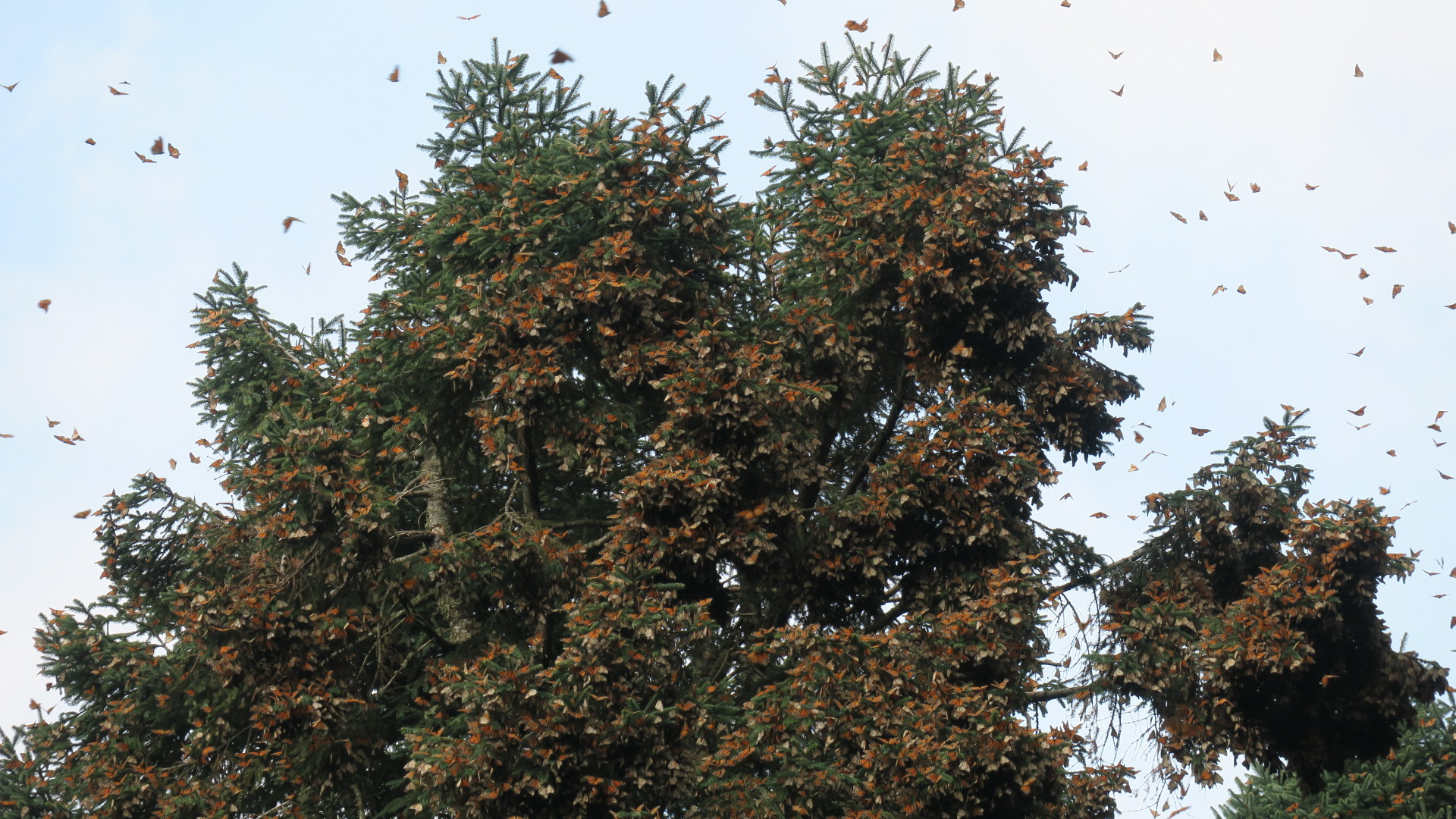
Dramatic beauty shall occur day by day at both sanctuaries from now on.
Estela Romero
Journey North
Angangueo, Michoacán, México
- - - - - - - - - - - - -
¿Cómo describer el viento corriendo suavemente en el bosque? ¿Las delicadas gotas de rocío brillante en las hojas de plantas y árboles al amanecer? ¿Las formas caprichosas de los racimos de monarcas en sus ramas de árboles de oyamel en sus sitios de hibernación?
El Año Nuevo abre con condiciones de clima mucho más generosas que las que tuvimos en Navidad. Días soleados y calientitos dan la bienvenida a la imparable oleada de visitantes tanto locales como internacionales que seguirá aumentando de aquí a Marzo.
El Santuario Sierra Chincua se mantiene en su mismo sitio aumentando en población y adquiriendo ahora una belleza indescriptible por la forma en la que se concentra y forma racimos de formas increíbles.
El Santuario El Rosario ahora se ha movido unos cuantos cientos de metros al sur a otro de sus puntos tradicionales de llegada llamado “Los Horcones”, 19.5952 -100.2617, entre ganando población pero reacomodándose también, lo que cambia la impresión del sitio cada vez.
Belleza dramática ha de ocurrir día con día en adelante, en ambos santuarios.
Estela Romero
Journey North
Angangueo, Michoacán, México
Estela Romero is an environmental educator with Monarchs Across Georgia. Reporting from Michoacán, her work is made possible by Monarchs Across Georgia and the Monarch Butterfly Fund.