

Eastern monarch update
By Estela Romero
With it being mid-January, a drastic drop in temperatures was expected in Central México due to a polar wave entering Northern México and heading southeast.
The polar wave did not hit Central México as drastically as forecasted. Apart from a wonderful rainy evening last Friday, our chilly weekend has been splendidly sunny too!
The colony in Sierra Chincua Sanctuary is now dispersing in concentration; the various heavy, wonderful clusters from last week have now dissolved, leaving only two of them. The rest of the colony gives the impression of having slightly diminished.
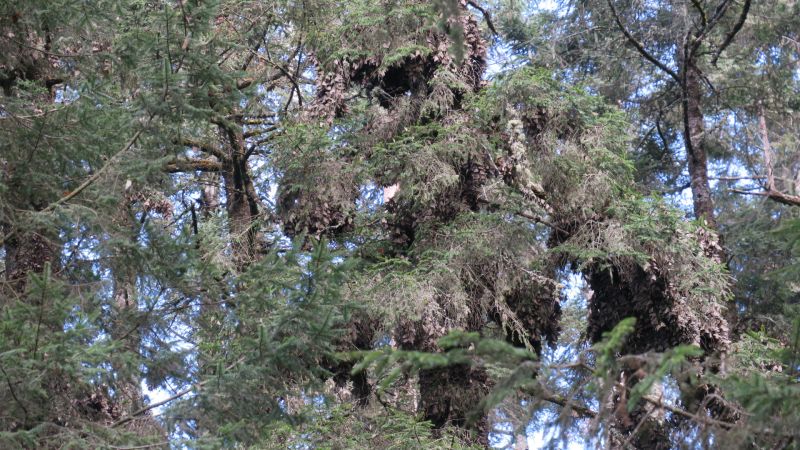
Local Ejidatario guides do not speak of a second separate colony anywhere around in this Sierra Chincua oyamel forest, and with no unusual mortality event having occurred, we could conclude that the colony is simply re-accommodating and fluctuating in population.
Winter blooming seems healthy and abundant, providing nectar for the hibernating colonies.
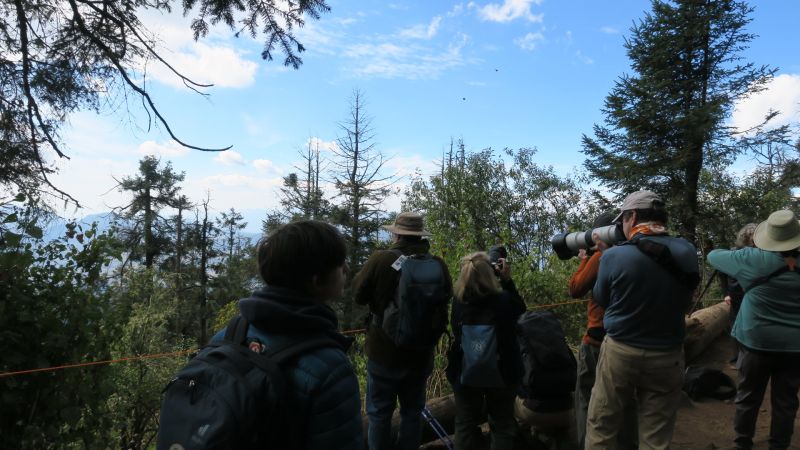
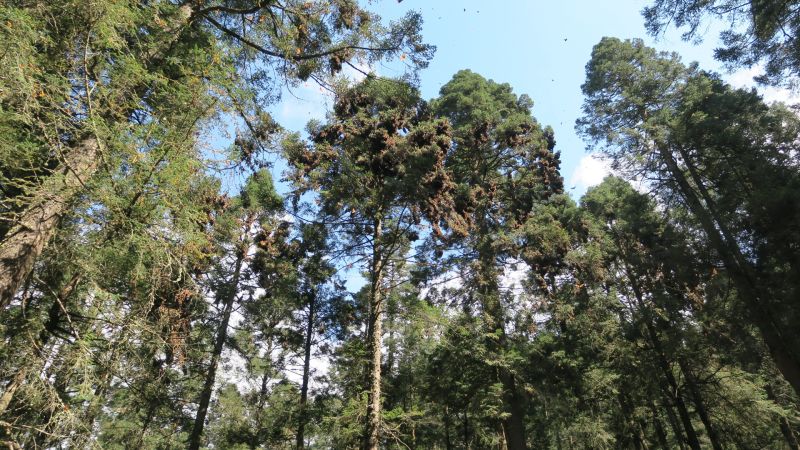
The colony in El Rosario Sanctuary has now moved a couple of hundred meters downhill, north-west.
While at first glance the colony appears to have dispersed slightly, once you position yourself in its center, you realize that the concentration remains in constant movement and moderate rearrangement.
Siendo mediados de Enero, era esperado que se anunciara alguna caída de temperatura debido a una onda polar entrando al Norte de México y dirigiéndose al sureste.
¡La onda polar no nos golpeó en el Centro de México como se había anunciado. Aparte de la maravillosa tarde lluviosa del Viernes, nuestro fin de semana ha sido, aunque frío, esplendorosamente soleado también!
El Santuario Sierra Chincua se ha dispersado en concentración en su mismo sitio; los varios racimos grandes que vimos la semana pasada se han disuelto quedando solamente dos de ellos. El resto de la colonia da la impresión de haberse disminuido ligeramente.
Los guías de Ejidatarios no mencionan la existencia de una segunda colonia en el área de bosque ni tampoco ningún evento de mortalidad que hubiese ocurrido, por lo que podemos concluir que la colonia se mantiene simplemente re-acomodándose y fluctuando en población.
La floración de invierno parece suficientemente sana y abundante para proveer de néctar a las colonias hibernando.
El Santuario El Rosario se ha movido un par de cientos de metros hacia abajo y al noroeste.
Cuando a primera vista la colonia parece haberse dispersado ligeramente, una vez que uno se ubica en su centro, nos damos cuenta de que la concentración se mantiene en movimiento y re-acomodo moderado.
Estela Romero is an environmental educator with Monarchs Across Georgia. Reporting from Michoacán, her work is made possible by Monarchs Across Georgia and the Monarch Butterfly Fund.
Western Monarch Update
By Gail Morris, Southwest Monarch Study coordinator
The weather along the California coast has shifted several times recently from windy, rainy weather to warm sunny days. The monarch activity responds to these ebbs and flows of temperatures and conditions in the groves in this week’s reports from the field.
Reports from the Field
Stephanie Turcotte Edenholm, Pacific Grove, California
Stephanie shares her encounters with counting monarchs at the Monarch Grove Sanctuary the past two weeks.
Jan. 9, 2026
We breathe in; we breathe out. They bounce up; they bounce down. Since last week’s count, with more wind and rain, our small contingent of Pacific Grove monarchs bounced down again. Our temperatures dropped quite a bit in the last two days, too. This morning, Jan. 9, it was 40 degrees inside the habitat. Where, reportedly, yesterday afternoon, there were clusters on the Eucalyptus overhanging the neighbor’s fence again, in the southern end, we found no monarchs this morning. The largest number we found was 20 on the Monterey pine along the footpath, “Nexxus." The 20 monarchs were spread across two branches on that tree and a few loners here and there, but not really clustered.
We found another five monarchs scattered, one in the interior and four on a cypress and eucalyptus along the hotel’s fence in the east. The total count was 25 monarchs. On Dec. 26, we counted three monarchs and then 131 monarchs the following week. I believe they have found a more protected place that we can’t see, and that our numbers will bounce back again in the following weeks’ counts.
Jan. 17, 2026
This week’s count was tricky … so tricky! It took us two days due to the warm temperatures here in Pacific Grove, California, the last four days. We began our count on Friday, Jan. 16, per usual. It was already 52°F when we started at 8 a.m. We did find clusters (21 and 14 monarchs) on a large Eucalyptus tree just at the beginning of the path into the grove.
There was another cluster of 15 monarchs on a low-lying branch inside the habitat in the south. The problem was that the majority of the monarchs were in the large Eucalyptus in the neighbor’s yard, high up and already flying in and out of the tree, landing in different spots. What we had suspected all along was confirmed, and that is that the monarchs were utilizing the western and southern sides of the tree, which are only visible from the street.
We also had several fliers high above us on the Eucalyptus branches along the fence. We decided a better use of our time was to scout from as many aspects as we could along the streets bordering the habitat and made a plan to return Saturday, Jan. 17, at sunrise and try the count again. Mind you, we had a firm count of 81 monarchs without having counted the fliers and the sunners in the large Eucalyptus in the neighbor's yard.
Today, Jan. 17, the temperature was cooler, 47°F, and there was a light wind, 7 mph ENE. We only found a single loner inside the habitat on the Eucalyptus that the day before hosted 15 monarchs. As I said in the beginning, this population of monarchs is tricky, or they have a funny sense of humor, observing 5 humans trying to locate them from day to day, week to week.
There were actually no visible monarchs until we returned to the streets and looked back at the grove, high up on the Eucalyptus branches. Once we found one cluster, we were able to locate more. We brought a scope so that we could actually get an accurate count. Once we located the monarchs, two counters remained on the street counting, while the other two went back inside to fill in the gaps that the others couldn’t see. To finalize our numbers, we all gathered to confirm we weren’t double-counting monarchs, cross-referencing notes and views. Our final count for Jan. 17 is 209 monarchs! It is a good thing that we began early because by the time we finished, the monarchs were already dancing in the sky again.
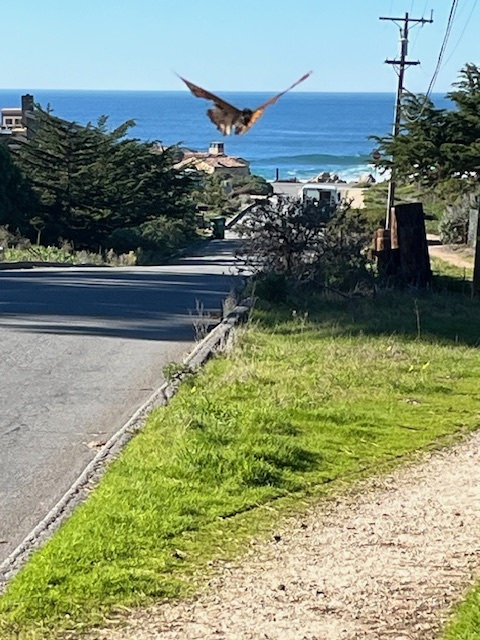
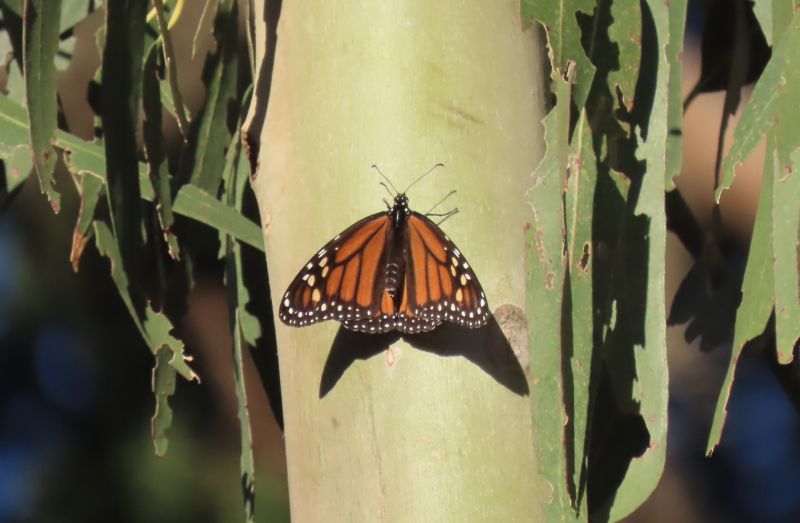
I have attached a photo from this warm week of what looks to be a tattered male, approximately 4/10 of a mile from the monarch habitat, one of the several that were out flying every day. It is not a clear photo; however, the behavior is clear.
Note: a previous version of this article stated that the count on Jan. 17 was 200 monarchs, not 209.
Diana Magor, Santa Cruz, California
Diana shares the recent monarch counts at Lighthouse Field, Moran Lake, and Natural Bridges.
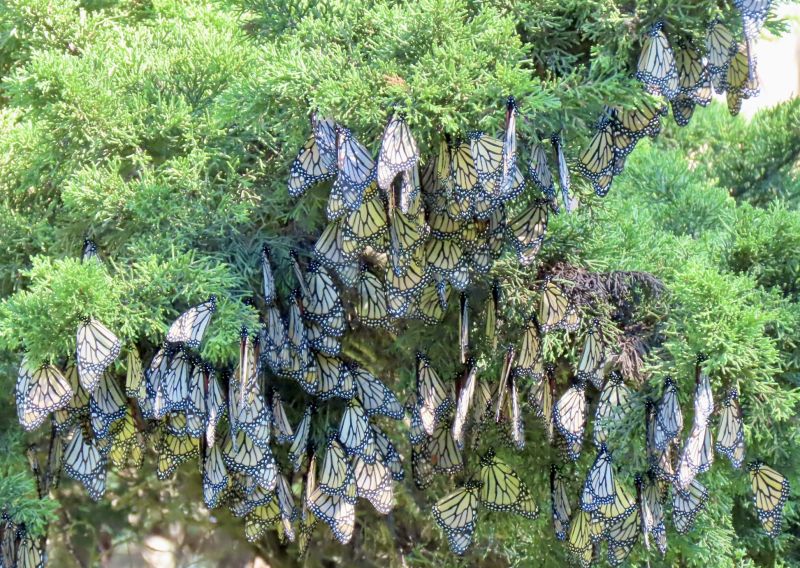
On Friday, Jan. 9, 2026, our count team did a monarch survey of Lighthouse Field. Dave Curley, our most recent recruit and hot-shot binoc guy who lives across from the grove, went out Thursday afternoon and found many new clusters forming on a large Monterey Cypress tree, designated as Tree 21, just across the eastern path from the Monarch Grove ‘’boundary."
The monarchs were all on higher southwest branches facing the sunset. The following morning, starting at 7:50 a.m, with temps at 39°F and clear skies, our team counted 366 monarchs on the mid to higher southwest-facing branches, mostly in clusters, on that tree, which was also the one they aggregated on last year just before dispersing from the colony.
Tara Johnson, our team member who counts from her excellent photos, counted 804 monarchs at Lighthouse Field that morning, including the 366 on Tree 21. Many, 342, were on the south-facing edge of the grove on the lower branches of Cypress trees 14 and 15 in clusters with a few singles. A total of 20 were found inside the grove on Tree 7, and only 76 on the north-facing branches of the formerly exclusively utilized Tree 12. All were on Monterey Cypress trees.
Moran Lake and Natural Bridges:
Beth Bell and John Dayton found only 340 at Moran Lake on Jan. 6 vs. 800 on Nov. 28 and 530 at Natural Bridges on Jan. 7 vs 2,500 on Dec. 4, both significant declines from earlier high numbers.
Beth and John found only one at the Escalona Gulch site and three at Rispin in Capitola.
This movement to Lighthouse Field from other overwintering sites is similar to last year’s decline in numbers from those sites to increases in numbers at Lighthouse Field from about early December to January 2025.
The numbers at Lighthouse this year (804 on Jan. 9) are below what they were last year at this time (1,323 on Jan. 10), but the overall number in all three Santa Cruz major sites is higher.
Thanks!
Thank you to Diana Magor and Stephanie Turcotte Edenholm for your reports! A shout-out to everyone: If you are seeing monarchs in the West, please report your sightings to Journey North. You can help us all learn where monarchs are this winter season and their movements.
Monarch sightings needed
Seeing monarchs? Your sightings help us present a balanced and accurate report of where monarchs are appearing each week. Report adult monarchs, eggs, and larvae to Journey North. Your detailed description of what you see can include, but is not limited to, the monarch’s gender and activity. If known, include the type of flowers if they are nectaring or milkweed type if laying eggs. Photos are encouraged and welcomed with all your reports.
Gail Morris is the coordinator of the Southwest Monarch Study (www.swmonarchs.org). She is also a Monarch Watch conservation specialist, the vice president of the Central Arizona Butterfly Association, and participates in several western monarch working groups. The Western Monarch News is based on your comments provided to Gail Morris. We hope to increase the number of sightings, photos, and comments entered into Journey North. We rely on the volunteers who communicate regularly with Gail and participate in our effort to increase awareness of the population of western monarchs. You can reach her at gail@swmonarchs.org.