


Western Monarch Update
By Gail Morris, Southwest Monarch Study coordinator
Warm temperatures blanketed the California coast with occasional cool waves, encouraging the growing number of monarchs to expand their movement beyond the safe harbor of their overwintering sites at the end of January.
Movement often accelerates in February as we monitor their spring dispersal. Meanwhile, adult monarchs have been reported in Fullerton, Death Valley, Sunnyvale, Berkley, and San Clemente in California, as well as Las Vegas, Nevada, and the Arizona towns of Phoenix, Superior, Tucson, and Safford.
Reports from the Field
Stephanie Turcotte Edenholm, Pacific Grove, California
Stephanie continues to track monarch numbers at the Monarch Grove Sanctuary over the past two weeks.
Jan. 23
The temperatures dropped back down to normal, a 55-60°F range this week in Pacific Grove. We even had a bit of drizzle yesterday, Jan. 22, and the evening before. I haven't seen any fliers in my yard since last week, when it was so warm.
I expected to find the clusters high up in the eucalyptus trees again this week. However, per usual, the cluster configuration was different, yet again. We found one loner on the outer, eastern boundary of the grove. The remainder were in two clusters: one larger group (71 monarchs) on a lower branch of a large eucalyptus overhanging the neighbor’s in the southern end, and another cluster in the southwest corner of the neighbor’s yard (north-facing side), relatively low down (56 monarchs). This is the same tree they have utilized in previous weeks.
We scouted inside the habitat and found no other monarchs. We used a spotting scope to check from the street, looking at all sides of the neighbor’s large eucalyptus, as well as the back sides of the fence line eucalyptus. We found no additional clusters. What we did do was accept an invitation into the neighbor’s backyard. From there, we were able to recount the clusters to verify our original numbers. So the number of 71 monarchs came from that recount, from the second vantage point. Initially, we counted 39 monarchs. It shows how important it is to view from as many places as possible. It’s also interesting to note that the temperature inside the grove was only 50°F, while the temperature outside was closer to 55°F.
Our total count for today, Jan. 23, is 128 monarchs. (Also, there was an error in the data from last week, and the official count for Jan. 17 was actually 209 monarchs.)
As an aside, one of the family members of the property we counted from recalled a memory from when he was a young boy. He shared that his grandmother told him that he wasn’t allowed to go outside because there were so many monarchs all over their property, including the ground, that he would surely step on them. I have memories from previous years and much larger counts, too, but probably not like his.
Jan. 30
The peak count of 12,206 monarchs for the 2025 Western Monarch Count is, indeed, low … but it’s higher than last year. And Pacific Grove’s population, while not one of the highest contributors to that number the last two seasons, is still a fraction of that number, and those monarchs have the potential to feed into the generations that will follow. Thank you to all the fellow data collectors across all the sites!
We did our official count in Pacific Grove, California, yesterday morning. I expect the numbers to be trending downward now. The temperature was surprisingly cool, 46°F, with a 9mph ENE wind making it feel even cooler. My apologies to those north and east of us experiencing truly cool/cold weather!
We found about 12 loners scattered on the east and southern side of the grove. The remainder of the monarchs we found were clustered on a few small, low branches, close together, on one of the Eucalyptus lining the fence into the neighbor’s yard- a return to where they were when our season began. Counting from inside the grove and again from the street, looking back, didn’t yield any different numbers than the 54 monarchs we observed. Our total count for Jan. 30 was 66 monarchs. Last season, we stopped counting on Jan. 5 when our count was already low at 67. We shall see how much into February 2026 we continue to count.
Diana Magor, Santa Cruz, California
Diana and her colleagues continue to monitor monarchs as they leave the Santa Cruz overwintering sites.
Jan. 30
We counted only 97 monarchs at Lighthouse Field on Friday, Jan. 30. (Less than half of what we found the previous week). Elizabeth Bell and John Dayton counted 380 at Natural Bridges (half what they found the previous week). This is not surprising, given the very warm weather we have experienced over the last few weeks. With climate change, this area has seen much higher temperatures much earlier in the year than in the past.
Thanks!
Thank you to Diana Magor and Stephanie Turcotte Edenholm for your reports! A shout-out to everyone: If you are seeing monarchs in the West, please report your sightings to Journey North. You can help us all learn where monarchs are this winter season and their movements.
Monarch sightings needed
Seeing monarchs? Your sightings help us present a balanced and accurate report of where monarchs are appearing each week. Report adults, eggs, and larvae to Journey North. Your detailed description of what you see can include, but is not limited to, the monarch’s gender and activity. If known, include the type of flowers if they are nectaring or milkweed type if laying eggs. Photos are encouraged and welcomed with all your reports.
Gail Morris is the coordinator of the Southwest Monarch Study (www.swmonarchs.org). She is also a Monarch Watch conservation specialist, the vice president of the Central Arizona Butterfly Association, and participates in several western monarch working groups. The “Western Monarch News” is based on your comments provided to Gail Morris. We hope to increase the number of sightings, photos, and comments entered into Journey North. We rely on the volunteers who communicate regularly with Gail and participate in our effort to increase awareness of the population of western monarchs. You can reach her at gail@swmonarchs.org
An update from Mexico
By Estela Romero
Feb. 9
Sierra Chincua Sanctuary and El Rosario Sanctuary continue showing a wonderful population concentration as the peak of the season goes on.
Some warm days alarm us by triggering early activity at the colonies, but they have now been contrasted with still-sunny but cooler temps, which bring hope for ideal weather conditions to prolong the hibernation status.
'This is really a unique place; there is wonderful blooming altogether with healthy, abundant underbrush, and these forests seem to be the winter home to an amazing population of hummingbirds nectaring all around, which surely come to spend the winter at these latitudes to later go back north in the U.S. and Canada, similar to what monarchs do,' commented a group of visitors from Cape May, New Jersey, amazed by the birdwatching experience in our fir forests.
Experts on conservation, leaders on research, foreigners, locals, dignitaries … no day without abundant visitors to the colonies now.
Mating is also getting started. There were a couple of pairs my camera could shoot.

Jan. 31
Brief and mild winter days alternate with sunny and rather warm days, which have started triggering early activity in our monarch winter population at both sanctuaries, Sierra Chincua and El Rosario.
Here today, our visit to the Sierra Chincua colony, which remains in the same exact location, this past weekend, Jan. 30.
Predation seems evident at the very core of the colony, with considerable numbers of dead monarchs within a relatively small radius. Wings in some individuals have started losing brightness, color, and texture, and their abdomens appear to be thin and drying out.
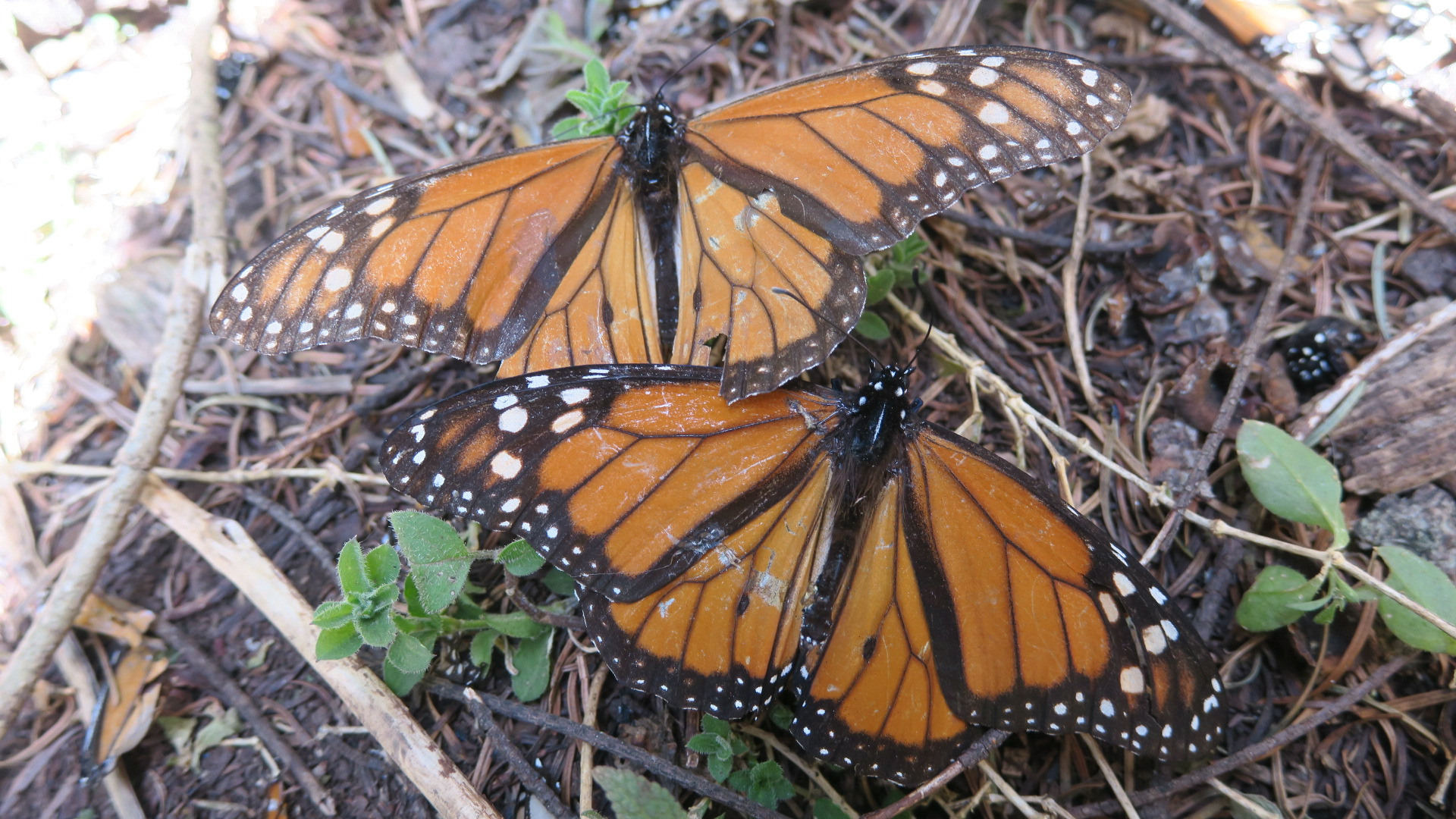
Concentration and size in the colony, which seemed dispersed last week, are again showing good size, including dense clusters, despite the activity these last few days. It's difficult to try to count the trees with butterfly populations.
Some winter events might still surprise us; however, conditions point to gradually warmer trends, which shall keep us attentive to the behavior of our great migration.
Estela Romero
Journey North
Angangueo, Michoacán, México
- - - - - - - - - - - - -
Feb. 9
El Santuario Sierra Chincua y el Santuario El Rosario continúan mostrando su maravillosa concentración de población mientras transcurre el pico de la temporada.
Algunos días soleados a éstas fechs nos alarman al motivar una unusual actividad en las colonias, pero ahora han venido a contrastar con días soleados pero que enfrían lo suficiente durante la noche con lo que las condiciones de clima pueden prolongar las condiciones ideales para seguir en su estatus de hibernación.
“Éste es realmente un lugar único; hay flores preciosas todo alrededor, abunda la vegetación y estos bosques parecen ser refugio de invierno para una considerable población de colibríes que encuentran néctar alrededor, y esperan su regreso a los Estados Unidos y Canadá, ¡similar al fenómeno migratorio de las monarcas!”
-Comentaron un grupo de visitantes de Cape May, EU, maravillados con la experiencia de observación de aves en nuestros bosques de oyamel.
Expertos en conservación, líderes en investigación, extranjeros, locales, dignatarios… no hay día sin numerosos visitantes en las colonias en estos momentos.
El apareamiento también está empezando. Había un par de parejas que mi cámara pudo fotografiar.
Jan. 31
Breves y moderados días de invierno alternan con días tibios y soleados, lo que ha comenzado a motivar actividad temprana en la población de monarcas en ambos santuarios Sierra Chincua y El Rosario.
Aquí hoy la visita a la colonia Sierra Chincua, que continúa en su mismo sitio este pasado Enero 30.
La depredación ha comenzado en el verdadero corazón de la colonia con números considerables de monarcas muertas dentro de un radio más bien muy pequeño. Las alas en algunos individuos comienzan a perder brillo, color y textura así como su abdomen delgado y reseco.
La concentración y tamaño de esta colonia, Sierra Chincua, que parecía dispersa la semana pasada, muestra buen tamaño nuevamente, incluyendo los racimos densos a pesar de la actividad de estos últimos días. Resulta difícil intentar un conteo de árboles con población, puesto que el área inclinada y con maleza lo impiden.
Algunos eventos de invierno podrían aún sorprendernos, sin embargo, las condiciones apuntan a seguir calentándose gradualmente, lo que nos mantendrá pendientes de la conducta de nuestra gran migración.
Estela Romero
Journey North
Angangueo, Michoacán, México
Estela Romero is an environmental educator with Monarchs Across Georgia. Reporting from Michoacán, her work is made possible by Monarchs Across Georgia and the Monarch Butterfly Fund.