
Finding their way: Monarch Orientation Mechanisms
Contributed by Dr. Bill Calvert
The means by which monarchs navigate from almost continent-wide breeding grounds to a dozen or so tiny areas of about one acre in extent in Mexico's Transvolcanic Belt has mystified monarch researchers for over half a century and remains one of the most intriguing questions of monarch biology.
One group of scientists from the University of Kansas* has shown that a sun compass is involved in guiding the monarchs to Mexico. This means that the monarchs are using the sun as a celestial cue.
Here's how this would work: Since the sun changes its "azimuth" (its direction with respect to north) during the day, unless monarchs always fly directly toward the sun (or at some constant angle to it), they must be able to compensate for the changing azimuth of the sun during the day. (Imagine for a minute: Where do you think the monarchs would end up if they simply followed the sun?)
To do this, they must know what time it is -- not hours and minutes, but whether it's early morning, late morning, midday, etc. In short, they must possess what researchers call a biological clock.
To show that monarchs have a sun compass, the Kansas researchers clock-shifted a group of monarchs and compared the direction of their migration with two other control groups that had not been clock-shifted.
One control group was subjected to the same conditions that the clock-shifted group had been subjected to-- a chamber where daylength was controlled by artificial lighting. (The day length was the same as natural day length for the season. The beginning and end were the same as natural sunrise and sunset.)
The second control group was wild migrants captured and maintained on a natural daylight regime.
The scientists released the butterflies and compared the flight direction of the three groups of monarchs. They carefully recorded the vanishing azimuths of the three groups and also noted the monarchs' body orientation.
What is body orientation, and why do you suppose that they needed this measurement? Monarchs are light creatures weighing about 600 milligrams during migration. They have relatively huge wings. Even light winds blow them about. They will not travel during high winds that oppose their migration. When light winds oppose their flight, they may cease flying or fly just above the ground. How do you think flying near the ground would help them against opposing winds?
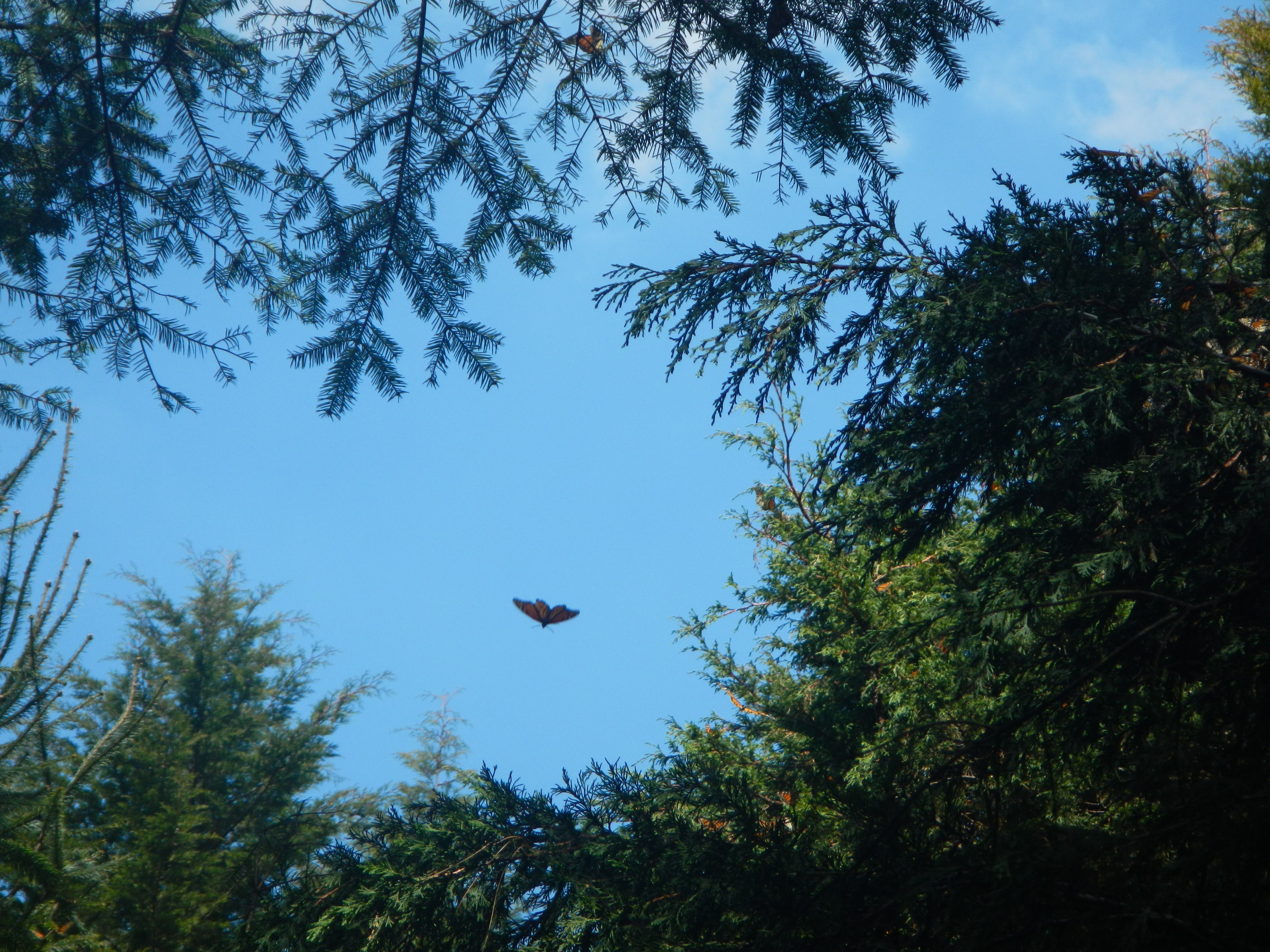
When the winds have a northerly component, they are up and off, flying to the southwest. Although the winds have a northerly component, they are seldom blowing perfectly enough to carry the monarchs directly to the southwest. Monarchs compensate for imperfections by facing into the winds and "crabbing" in the desired direction. The direction they are facing may be a better index of the direction they want to go than the wind direction. This is why researchers pay attention to the direction the monarchs are facing.
The clock-shifted monarchs were faced nearly 90° differently from either of the control groups. If, for example, all groups were released at 10 a.m., the control groups were faced at azimuths that were large angles with respect to the sun as would be appropriate for butterflies flying southwest in the morning when the sun was in the east. The clock-shifted group was faced at azimuths much closer to the azimuth of the sun as would be appropriate for butterflies flying six hours later at 4 p.m. when the sun was in the west. Clock-shifting experimental animals is a much-used method, especially in bird research, to demonstrate that the animals are using the sun to orient.
It has been proposed that monarchs also use the Earth's magnetic field to orient as many birds do. But so far, no one has produced consistent evidence to demonstrate this
* The authors were S.M. Perez, O.R. Taylor, and R. Janders. 1997. A sun compass for monarch butterflies. Nature 387:29.
Finding milkweed
An Urgent Hunt
When monarchs arrive from Mexico in the early spring, milkweed is beginning to emerge. Female monarchs must find milkweed quickly. They are at the end of their lives and have eggs to lay. Milkweed is the only food monarch larvae will eat, so finding it is of the utmost importance.

An Everyday Miracle
Monarchs find milkweed in places and ways that astonish observers. Kathryn Cole could not believe her eyes. "Milkweed just broke the ground yesterday and grew 3 inches in one day. We began checking for eggs and, sure enough, a monarch had already deposited her eggs on the newly emerging plants."
A Touch of Milkweed
Dr. Bill Calvert describes what he observes in the field:
"The female flits over the field and, when she stops on a plant, she drums the surface with her forelegs."
The forelegs are tiny, close to the head, and difficult to see. How do the forelegs help the female find milkweed?
A Combination of Senses
"Monarchs use a combination of visual and chemical cues to find milkweed," says monarch scientist Dr. Karen Oberhauser. "Once they land on a plant, they use sensory organs on their feet and heads to tell them if it is a milkweed, and probably the quality of the milkweed."
A Look at Senses
It's difficult for scientists to study monarchs' senses because an insect's senses are so different from ours. Yet even our own senses are mysterious. When we smell and taste, we are actually sensing chemicals in our environment. People and monarchs do this in a similar way.
Chemoreceptors ("KEE mo ree CEP terz")
People and monarchs sense chemicals in the environment with special structures called chemoreceptors. They come in different shapes and sizes, but they work in the same way. When a chemical fits a receptor, the way a key fits a lock, the brain identifies the chemical.
Antennae Have Chemoreceptors
Monarchs use their antennae to detect plant chemicals. The antennae are covered with chemoreceptors, especially at the tips.
Legs Have Chemoreceptors
All six of the female monarch's legs have chemoreceptors. Look closely at a monarch's midlegs and you'll see the sharp spines monarchs can use to cut the plant and release the chemicals that tell the monarchs it's milkweed.
Eyes
Eyes sense light, not chemicals. Monarchs have compound eyes with thousands of lenses. They see thousands of single images at the same time. Monarchs can see in all directions at the same time, too. They don't see the world in a single image the way we do. Their vision is specialized for seeing colors, direction, and movement.
Confusing the Senses
Some plant species grow together in groups called 'guilds.' Together, the plants defend themselves by producing a mixture of plant odors. Herbivores, like monarchs, can't find the correct host because there are too many confusing odors. This would explain why monarchs need to use a combination of senses to find milkweed.
Field of Green
Picture a monarch floating through the air, following invisible scents to find the milkweed it urgently needs. Watch how a butterfly can locate milkweed that's hidden in a sea of green plants.