
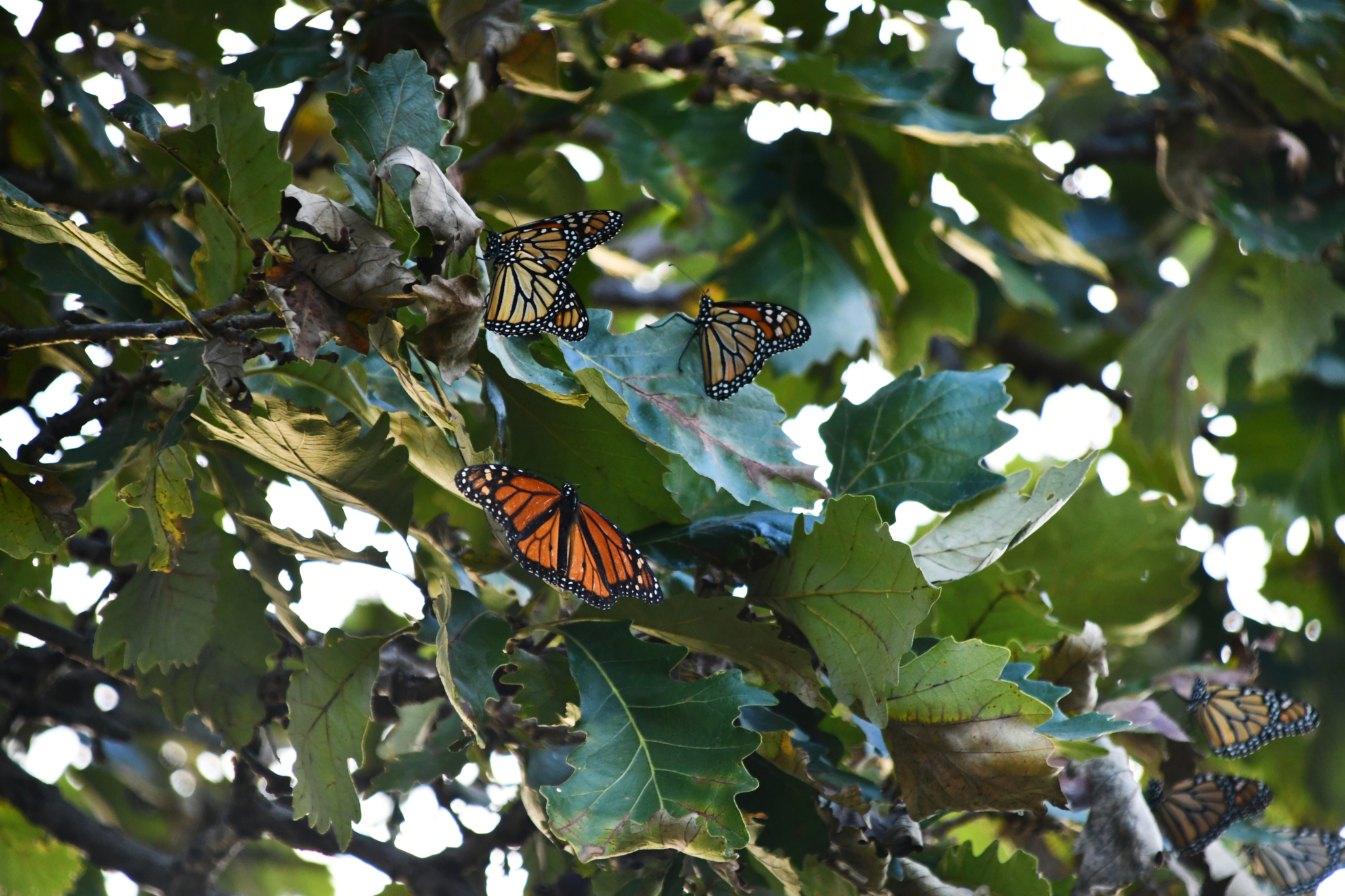
Monarch butterflies migrate alone during the day. They come down at night and gather in clusters, called roosts.
Some roosts have only a handful of butterflies, while others will have hundreds or even thousands. Some last for only a night or two, while some trees will be filled with monarchs for a week or longer, and some areas will be used year after year as monarchs make their annual southbound migration.
Those who know where to find monarch roosts may have an annual opportunity to see them, but for others, seeing monarchs flowing into a tree or group of trees is a rare sight. Wrote one Journey North observer: "The air resembled a monarch airport, with monarchs coming in from every direction, floating through the air, checking out various trees, landing, then taking off again. When one butterfly approached a cluster, the roosting butterflies flashed their wings. It took from about 7:15 to 7:35 p.m. for them to cluster in the trees, just before dark."
Having trees that provide some shelter from the wind as well as nearby nectar sources may be two important considerations as monarchs choose roost sites.
One hypothesis for why monarchs roost is that it's an anti-predator strategy. Cool temperatures paralyze monarchs, making them vulnerable to predators, so a roost could provide some safety in numbers.
Journey North has been tracking roosting behavior using the reports of community scientists like you for nearly three decades. As roost reports move south, the fall roost map reveals the progress of the monarch migration.
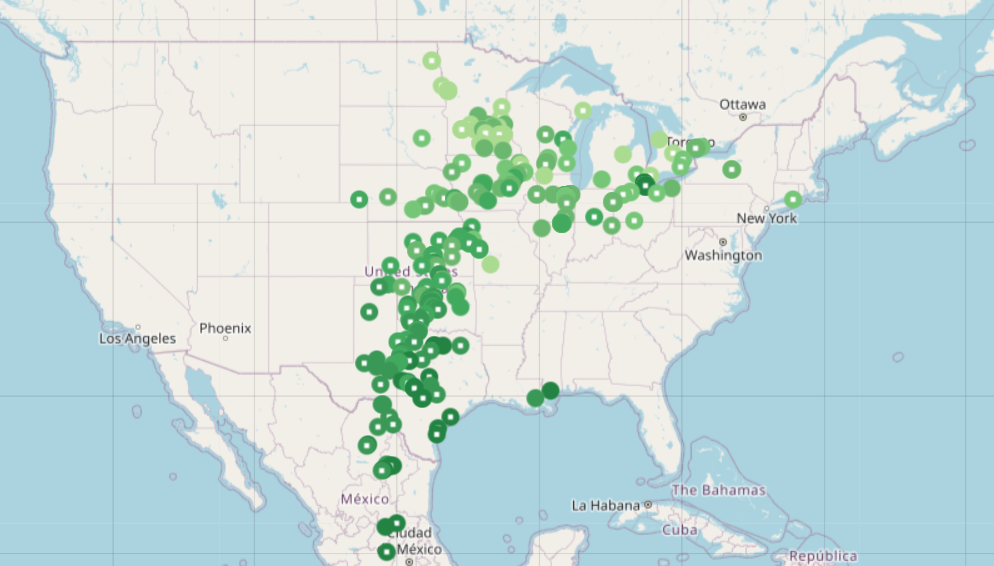
If you see a monarch roost, whether it's five monarchs or 5,000, report it to Journey North! If you want to see one, consider looking for them in spots where people have reported them in past years. For example, Point Pelee National Park in Ontario is a known roosting spot, as it provides the southernmost point of land before monarchs are forced to cross Lake Erie. Others are less obvious, but may form multiple years in a row or multiple times during the same season.
Take a look at the Journey North maps to see where roosts have been reported near you over the years.
Do monarchs use the same roosts every fall?
By Dr. Bill Calvert
People often ask why monarchs roost where they do during fall migration. Do they rest at the same sites every fall? Many people swear that they do, but the answer is clearly no. Their use of a particular roost site depends on several factors. The list below may not be complete. And even the 'perfect' roost site — with all or many of these characteristics — will not always have monarchs roosting during the migration. There are simply too many variables that change from year to year.
Here are factors to consider:
1) Where were the monarchs before they reached you?
This factor is the most important. Monarchs travel each day with the winds. The migration is often synchronized in the form of waves of butterflies that pass over a particular point. If the monarchs' starting point is a distance upwind from your position, such that the wind has an appropriate velocity and duration to carry them to you, butterflies will "fall out" (to borrow a birding term) and you will be graced, and perhaps dazzled, by their presence.
2) Are you on a principal flyway?
If so, your chances of seeing roost trees are much improved. A principal flyway is very likely defined by its geographic location along a path from a principal breeding area to the Sierra Madre Oriental Mountains of Mexico. (This latter mountain range seems to focus the migration in Mexico, and direct it towards the overwintering sites located in the Transvolcanic Belt of central Mexico.)
3) Are nectar sources close by?
Nearby flower fields definitely improve your chances of seeing roosts. Often, monarchs will come down in the afternoons to feed. As the sun sets, they stop feeding and fly to nearby trees where they commence a search for each other to form "transient night-time roosts."
4) Does the site provide protection from the wind?
Monarchs will roost downwind of the wind direction when they form their roost. Sometimes the wind reverses at night, and they are caught in positions exposed to the wind.
5) Are you in a stream valley or depression?
Especially in dry climates, monarchs seem to be attracted to cool, moist areas. When winds are coming from the south, they seek out these "riparian" areas to relax and hang out until the winds turn around. Once they do turn around, the monarchs are gone in a flash. Also, in dry climates, they prefer protected shelters afforded by overhanging trees. In the main flyway, an arc of oak or pecan trees over a stream channel will almost always yield a roost of migrants.
6) Do you have an oasis of trees?
In an area otherwise clear of trees, monarchs are often attracted to oases of isolated trees.
How do monarchs find roosts?
In the 1980s, some research was done to identify a marking chemical that attracted butterflies to the Mexican overwintering roosts. It was reasoned that if each monarch left a trace of marking chemical, the more monarchs there were, the easier it would be to detect the marking chemical--and find the overwintering sites. The results were negative. By default, it appears that monarchs find their transient roosts visually. They look for silhouettes of trees from a feeding position, or perhaps, they can spot a riparian valley from the air. Butterflies observed descending into a wooded valley in central Texas suggest that they can do this. Once they have descended, they begin their search for each other.